Photography GuidesApril 10, 2026– 14 min read
The North Burren Coastline — Castles and Towers, from Black Head to Kinvara
I had only moved into the area that my little gang already was making plans to get to the beach. Any beach they said, along the Burren coast! Growing up in the South of France where sunshine prevails from April to October, making it ideal to enjoy life at the beach, I was not surprised that my kids wanted to get back to the water again.
Unsurprisingly, it took a little while to adapt, from the gentle warm breezes of a welcoming Mediterranean sea, to the vivifying gusts and gales of the wilder Atlantic ocean, but we did! As often as we could, we would pack the car with buckets and spades then, later on, beach games and swimming suits, to head off to Traught beach, Flaggy Shore or even the beautiful Fanore further south, on one of those day trips full of surprises. With kids growing up alas, there are fewer family trips to the ocean, though still all those outings gave me some comfortable bearings to start exploring the coastal landscape around the Burren with a camera.
The northern edge of the Burren coastline, between Kinvara and Black Head, is marked by a series of small castles and towers that sit close to the sea. Here I present those landmarks and some great coastal locations in between. I visit at any time of the year though preferably during the warmer months for those spectacular sunrises and sunsets which I also capture, with much pleasure and commitment, around the Burren Lowlands , a little closer to my homestead.
New to the Burren? You might want to start with this introduction: the Burren: a land of stone .
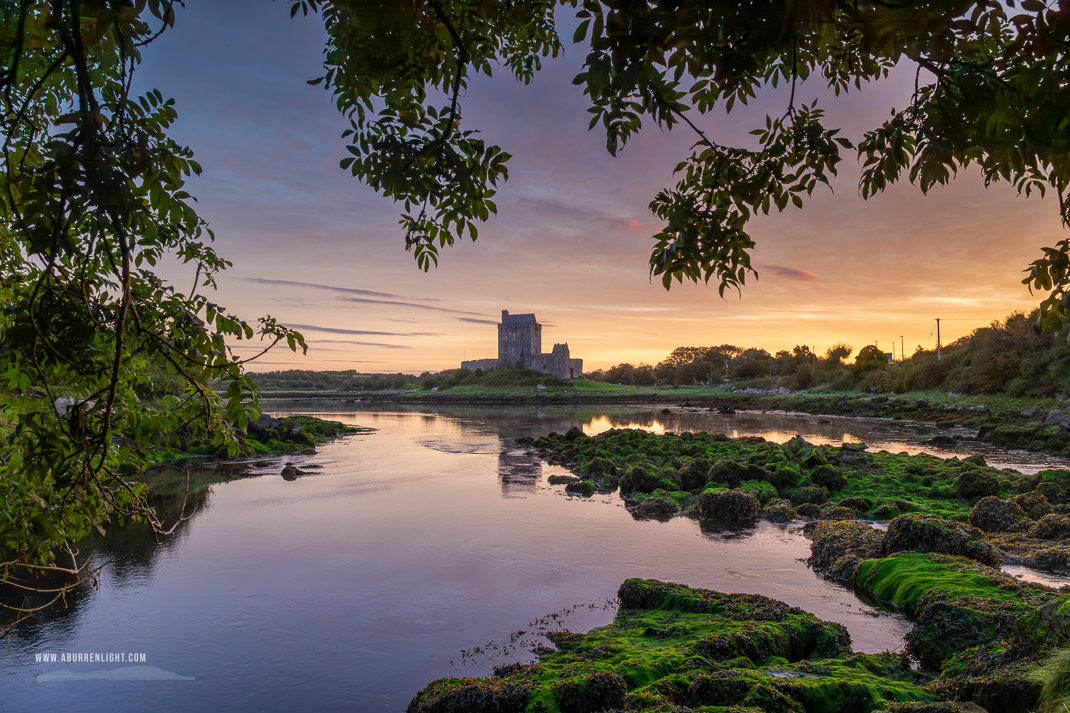
Dunguaire Castle, Kinvara
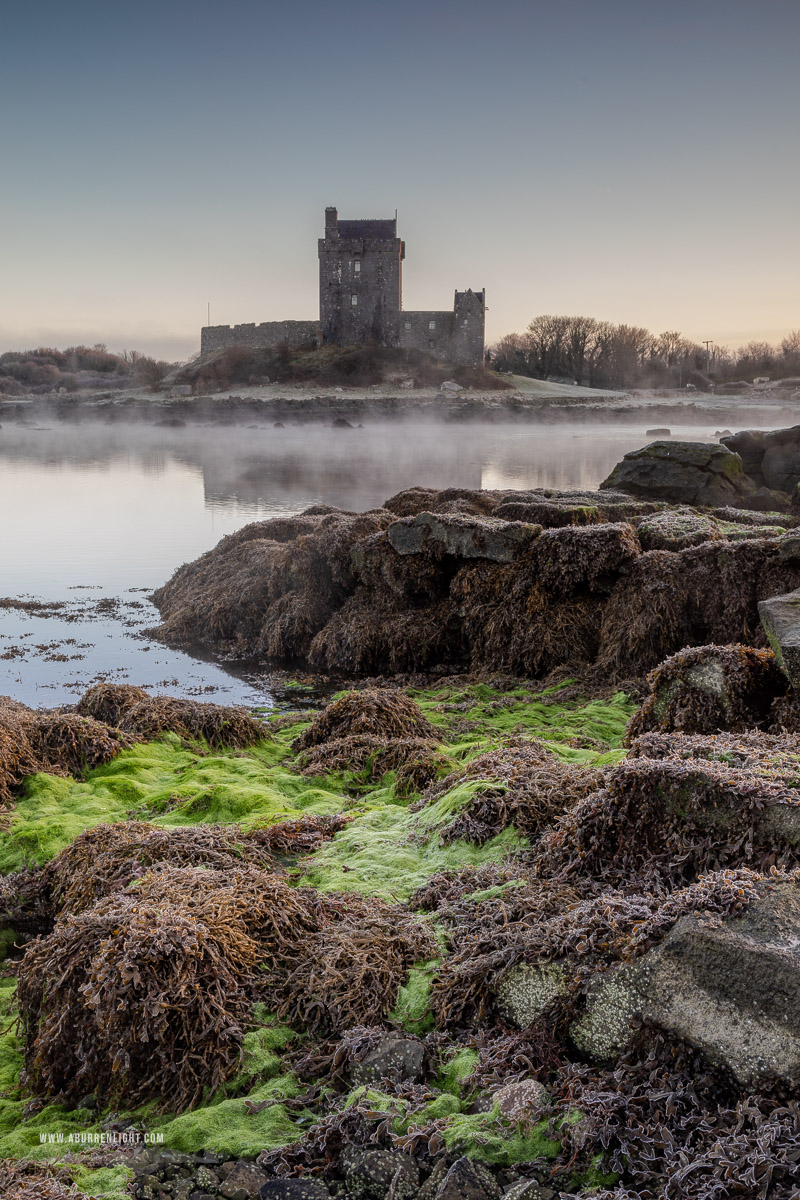
The first time I want to Dunguaire was on a very cold winter morning in 2019, shortly after I picked up photography again and started the project. I was driving in freezing fog condition with very little visibility on the road, and a hope that not all photography outings would start like this!
All the same, it was very exciting. Fog and frost don't come by together too often and it usually gives some pretty great atmospheric photos. I reached Kinvara, parked on the road and very carefully walked and even climbed my way in front of the castle, on the little inlet which still hosts the remains of the very first stronghold built for the King Guaire of Connacht, as early as the 7th century.
Dunguaire, as many similar Irish castles, would not be what you would typically call a castle in mainland Europe: it is small, and quite the low build, more of a tower house really. Still, it is a beautiful landmark, the pride of Kinvara, great to capture at sunrise and sunset, preferably during the warmer months to have the sun and a better chance at colourful clouds in the picture, and either at high or low tide (though the high tide will stop you from reaching the inlet in front of it and you'd have to photograph from the shore)
As debatable as this can be, this is signed as private land, be respectful! No one is going to hunt you down, but please leave the place as you found it. More of Dunguaire
Traught Beach, the Doorus peninsula
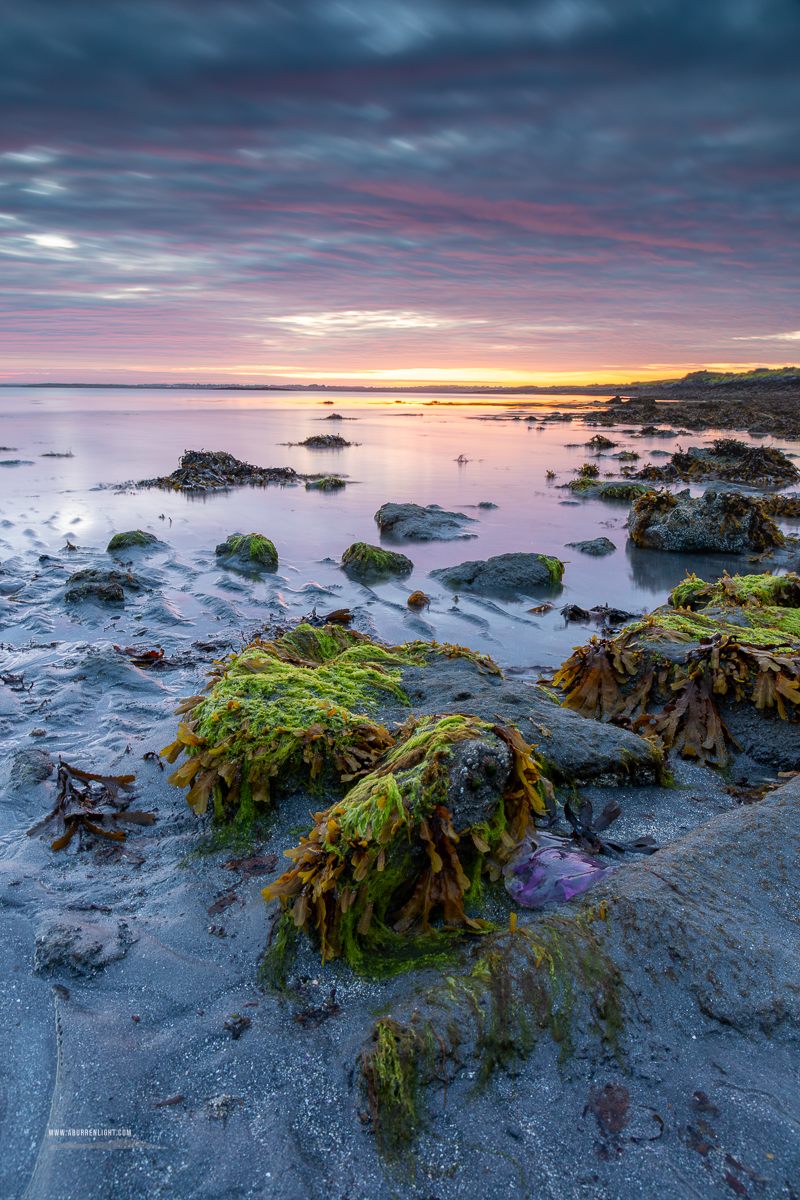
Traught beach is the closest beach to Kinvara, the 'nicer' beach with ample car park, making it popular with adventurers, dog walkers and beach goers at any time of the year. In the summer there is even a mobile sauna coming to the beach! I particularly like the 'less' frequented side of Traught, away from the car park and into the area full of algae covered rocks surfacing at low tide. Right there, from May onward, sunrises can absolutely stun, one just needs to get up at crazy o'clock but it's well worth it when it does its magic .
It is probably a coincidence but every time I have been to Traught for a stroll or a photo shoot, jellyfish were abundant: the 'interesting' ones. the purple ones. I would use those as part of the foreground when I'd run out of sand ripples and other interesting rocks.
I will enjoy being there at any time of the year. In cooler times the sun would rise behind the beach but there are options to make some nice shots, particularly with the beach watch cabin somewhere in the frame. Mostly, it's a beautiful and peaceful place to visit on most days, enjoying the views over the other side of the bay.
The Aughinish Peninsula

There is something so peaceful about the Aughinish peninsula. Perhaps for its remoteness, a dead ended and very narrow road branched out of a really not that much wider road leading to Traught beach, on the Doorus peninsula. It is quiet and peaceful, very few cars driving along, just the sounds of nature. A few curves and I find myself near the far side of the Burren hills, where the road comes to an end. During the winter months, with the sun rising farther south-east, Aughinish probably is the best place to catch a nice sunrise on that side of north Burren.
On one side, the tidal bay separating us from mainland and, on the other, the choppier North Atlantic Ocean. There are no clints and grykes here yet the view from Aughinish makes it so evidently Burren!
Did you know? The Aughinish Martello tower is the last one with a real bronze cannon on top!
Rosshill beach, the Aughinish Peninsula
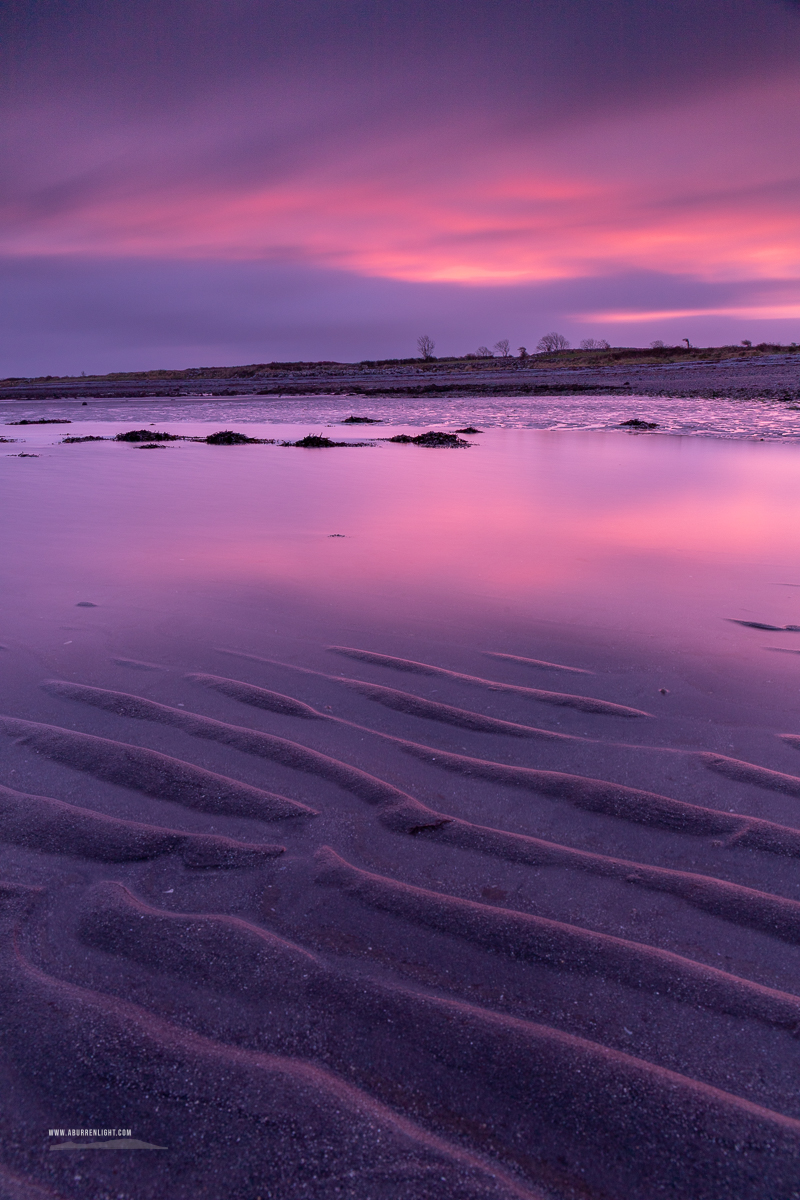
My first time at Rosshill beach was on a very cold yet dry December morning, with a bitterly cold -9C clocking on the thermometer. I was only exploring Aughinish then, and that little right turn in a curve often caught my attention. As I drove onto the access road that morning, I realised I was not going to be alone, as a little group of people was getting ready to get in the water! How brave! It wasn't hard to convince myself this wasn't for me and to go the other side of the beach
Twilight was really magical that morning with hues of pink and magenta in the sky reflecting on the ground. This is when I found out that Rosshill beach had the most wonderful sand ripples of the whole Burren at low tide. A great way to frame the wider ocean, or the Céibh an Lochán also known as Paradise pier on the other side of the beach, a reminder of a past and busier century on the peninsula.
Aughinish has mostly reclaimed its quiet days since, if only for that bunch of joyous people getting used to the freezing water temperature on that very cold winter morning.
The Flaggy Shore

Hopping back to the coast from the peninsulas we are slowly moving away from Kinvara as we are heading south, looking at what is perhaps the most popular walking spot for Burren locals and tourists alike: the Flaggy Shore. This long, narrow stretch of road along the coast provides some stunning views other the Galway bay and Burren coast all the way to Black Head, which you can see in the photo I selected. It's also the first location where clints and grykes meet the ocean, as we travel towards Ballyvaughan. These are layered on top of being all crackled down by the eroding water, do ensure you visit at lower tide for good use of the photo potential.
As spring rolls in, the stone warms up and a sheer amount of flowers (lots of sea thrifts!) emerge from anywhere a little bit of dirt can be found, a gryke or a patch of green on the side of the limestone pavement.
It really is a beautiful and inspiring place which I love to visit at mid tide for sunrise to catch some foreground (great pebbles on the far end of the shore), or on a summer evening waiting for a light hopefully as good as the photo I chose.
Whatever you decide to do, do not miss the homemade ice creams to taste at the Linnalla ice cream parlor, on top of the hill facing the Finavarra hill, at the end of the road. Well worth the little hike from the shore!
The Martello tower of Finavarra
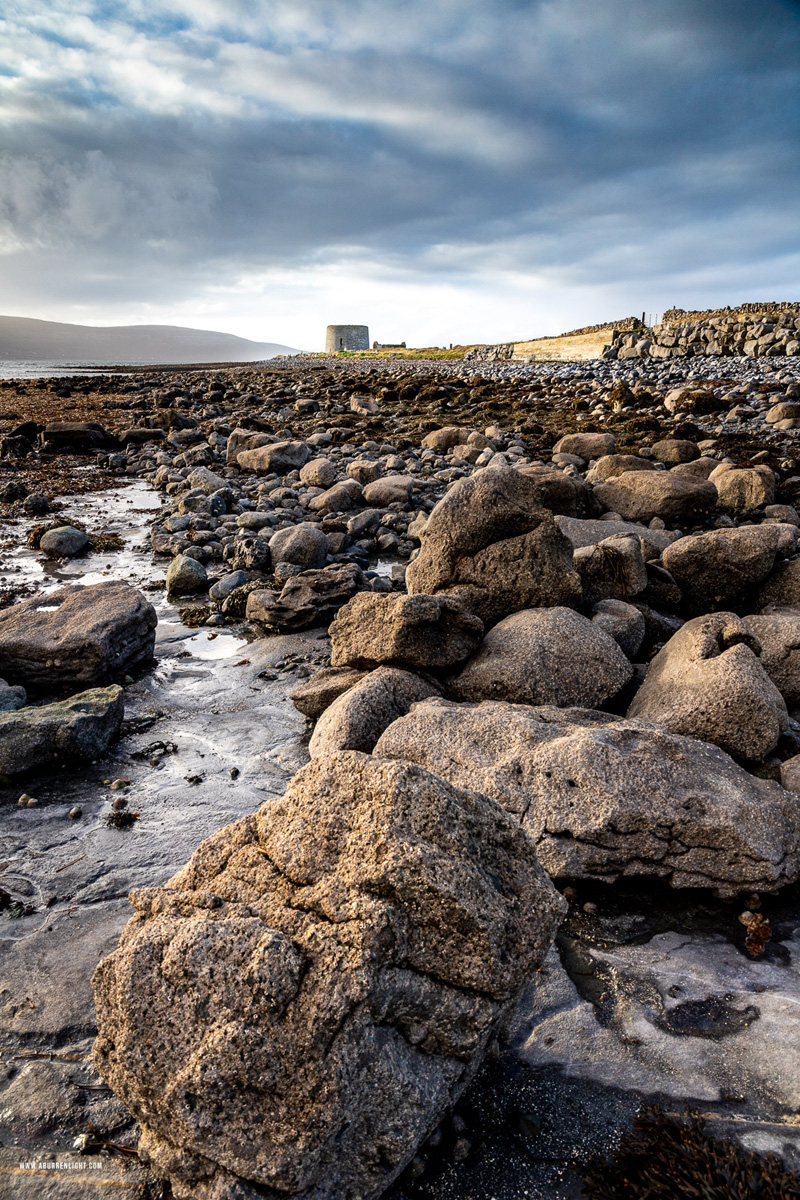
Aside of the Linnalla parlor ice creams which you should not have been able to avoid by now as there is direct access from that road, is a great little Martello tower still standing strong, defying the test of time. The road ends as a cul de sac where you will find some space to park a car, allowing you to venture as I did, in search of a good foreground to frame this landmark.
Along the Burren coast, Martello towers stand as compact, circular sentinels of a tense moment in early 19th-century history, when fears of a Napoleonic invasion prompted Britain to fortify vulnerable shorelines.
Built of thick limestone walls with elevated entrances and gun platforms on the roof, these towers were designed to withstand cannon fire while commanding wide views over Galway Bay, to anticipate any incoming agression.
In the sometimes stark, elemental landscape between Black Head and Finavarra, they fit right in with the Burren itself: weathered by Atlantic winds, softened by lichen, framed by karst pavement and wild seas. Today, they lend a quiet sense of watchfulness to the coast, blending military history with the raw, timeless character of this stretch of coastline.
The Seán Muckinish tower house, Ballyvaughan
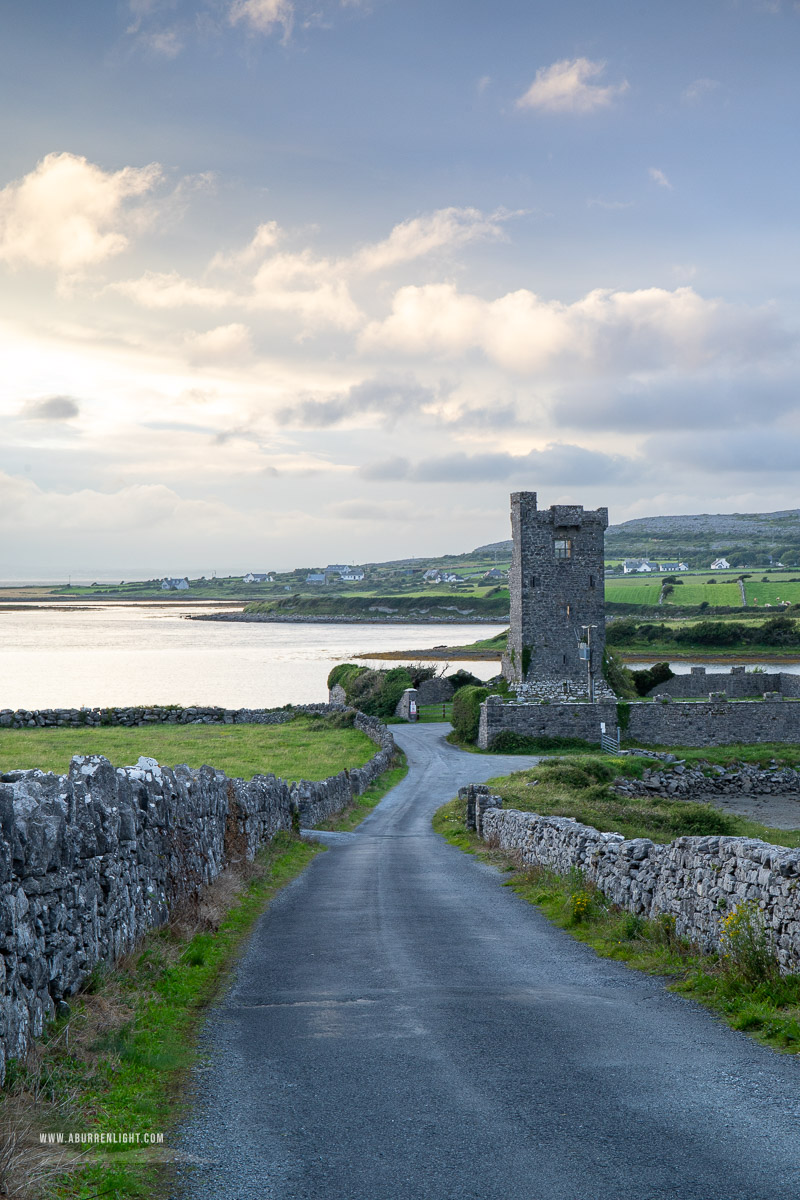
It's one of those views that catches you entirely by surprise the very first time you take on the N67 to Ballyvaughan: the old 'new' tower house of Seán Muckinish, also known as the Muckinish West tower house.
Although collapsed on one side (exposing its internal vaulting), it still stands as one of the Burren coast’s most evocative relics of the 15th century. Built in 1450, much earlier than the period of Napoleonic anxiety which saw the Martello towers being erected for protection, it occupies a wonderfully exposed position overlooking the peaceful Finavarra land.
I particularly like the tidal bay at its base and the potential for really great sunrise shots in spring and at low tide (don't go too far though the ground is quite treacherous), when the sun rises somewhere behind the tower. I find the tower has a very 'cartoony' look from its side! I've even captured the auroras and the milky way there as it's quite a dark spot on the coast, during a new moon.
There is a less accessible 'old' Muckinish tower house further into the Bell Harbour inlet which, funnily enough, appears in better shape than its 'new' sibling.
Bishop’s quarter beach
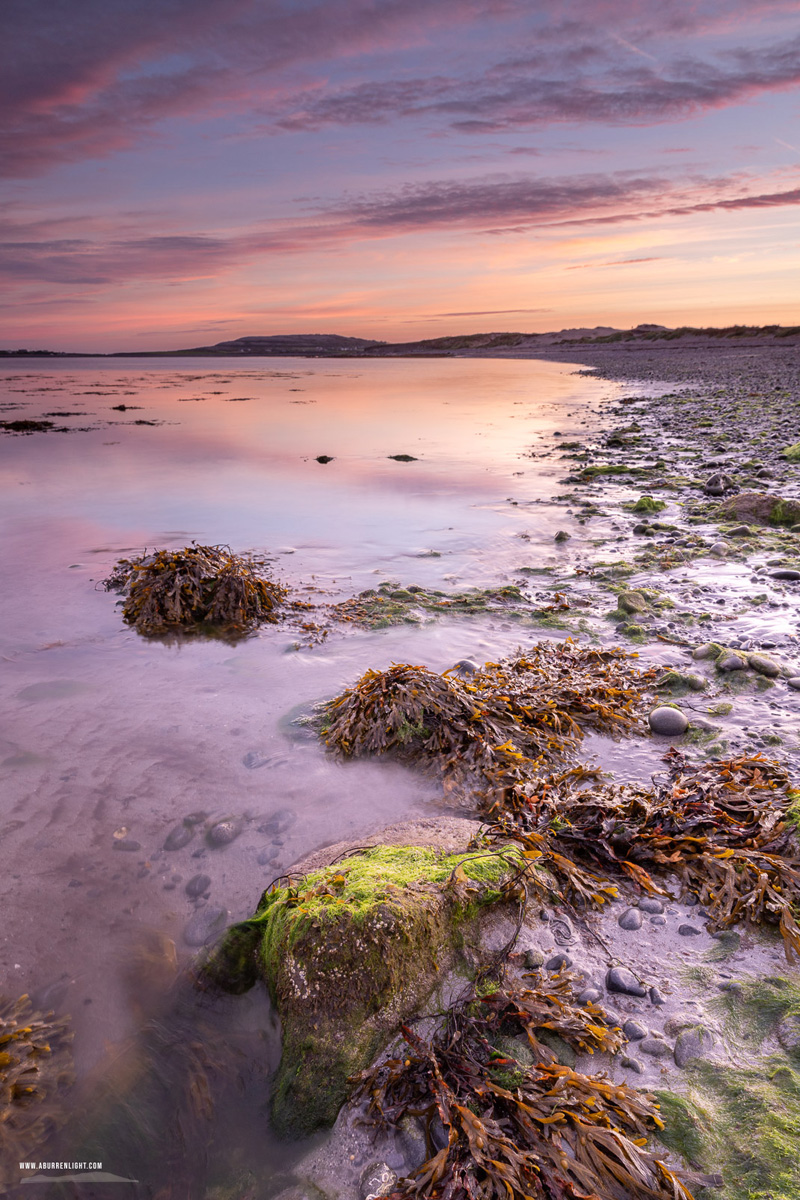
Driving down a narrow bumpy road from the N67, a kilometer or so from the old Muckinish tower, brings you to Bishop's quarter beach, which doesn't really have any connection with the old ruins of Bishop's quarter, aside of being geographically close and literally 'down the road'.
Bishop's Quarter Beach is one of the Burren coast’s most accessible yet quietly atmospheric shorelines, where the stark limestone landscape softens into a gently curving strand along the Galway Bay. Framed by low hills and wide skies, it carries a slower, more contemplative mood than the wilder stretches of the coast, with soft light reflecting off the bay and long horizons that seem to dissolve into the Atlantic.
It has a little dune system at one far end and a very rocky shore at the other, providing quite a few opportunities from sunrise to sunset and preferably in the warmer months as, in the winter, the sun rises and sets behind the beach and over the Burren hills.
Perhaps a little more anecdotic is that morning when I took this photograph: the temperature was very low (-4C) and it was still quite dark when a ghostly shape of a person appeared. It was a lady going for a swim further along the beach, in a swimsuit, covered with a large white towel. A fine lady! We had a chat, she literally haunts (pun intended) that very beach every morning to go for a swim in the ocean. comes rain or shine!
The Rine Peninsula

I was introduced to the Rine by two fellow photographers, and immediately fell in love. It would become my favourite destination that summer of 2020, and the many following months. The Rine Peninsula stretches quietly into Galway Bay as one of the Burren coast’s more understated and intimate landscapes.
Just beyond the village of Ballyvaughan, this low-lying finger of land is a subtle blend of limestone pavement, salt-swept grass, and tidal edges that shift with the rhythm of the bay. Unlike the more dramatic Black Head nearby, the Rine Peninsula feels grounded and expansive, offering long, open views where sky and water dominate the frame.On a quiet day, the sky and surrounding hills reflect in the ocean offering a dazzling view over the bay, all the way to Finavarra. This is definitely a spring and summer destination unless you're not a great 'sun in the frame' lover and are heading out on a dark moody day in November to catch some Burren drama.
One of my bucket list locations! Have a look at the Rine Peninsula .
Did you know? It is called the 'Rine' as this stretch of land belongs to a cooperative of German nationals! This is private land, there is livestock, please be respectful and keep dogs on a leach.
The tower at Gleninagh
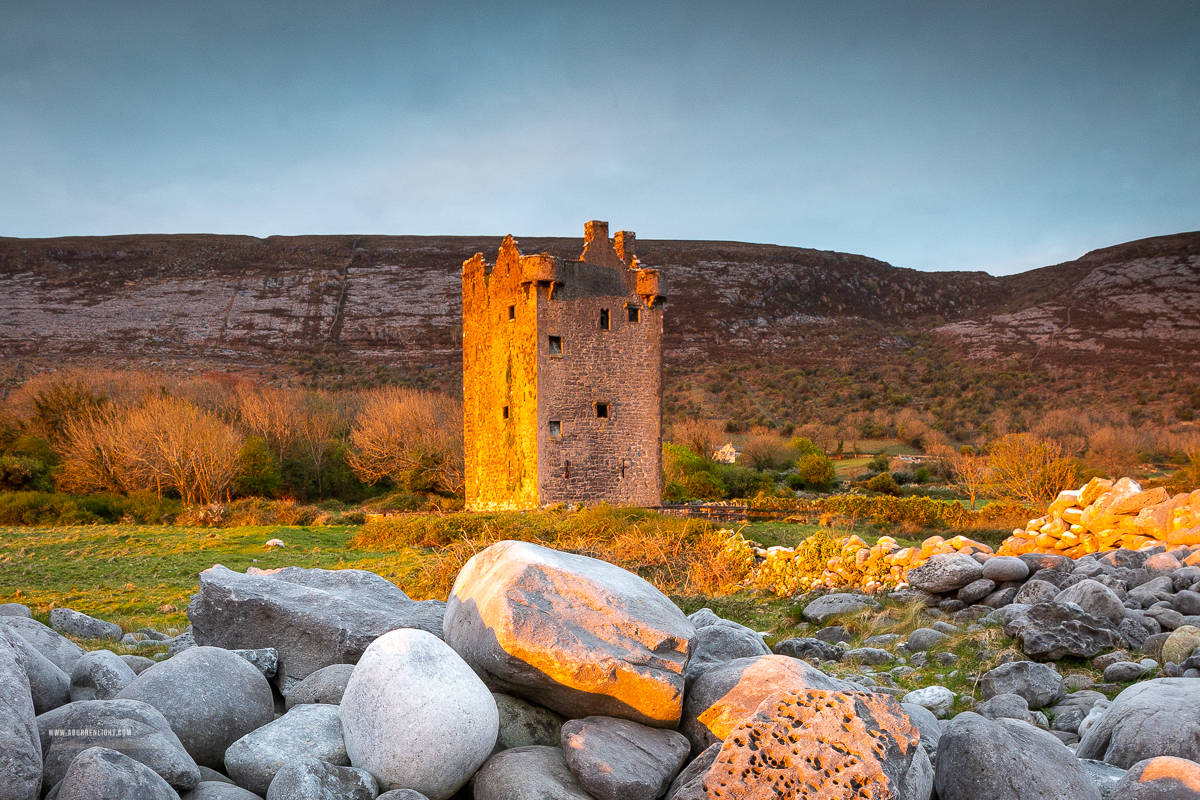
Gleninagh Castle rises in quiet isolation along the Burren coast, a striking 16th-century renovated tower house set against the vast openness of Galway Bay. Built by the O’Loughlin clan, it stands just inland from the shoreline, where limestone pavement stretches toward the sea.
It is not the easiest to see from the road, in fact if I did not see it from the Rine peninsula, I probably would not have known it was there.
The narrow road leading to the castle also brings you to a very nice pier, as well as a pack of territorial yet friendly dogs who will glady pose for a picture or two standing on the pier wall!
Likely constructed in the 18th or 19th century, this pier served the local farming community around Gleninagh, providing a vital link to Galway Bay at a time when roads across the Burren were poor or non-existent. From here, turf, seaweed, limestone, and agricultural produce could be loaded onto small boats, while supplies and goods arrived in return, tying this remote stretch of coast into a wider network of trade and survival. A nice photo of the Gleninagh pier in the blue hour .
This concludes an overview of the North Burren coastline. I hope this gave few a few ideas to go out with a camera and brave the elements for some nice images. What connects all of these locations is less their scale or prominence (there is no building too 'grand' on the coast), but more the conditions in which they are seen in the overall karst landscape. Light, weather, and timing have a strong influence on how each place appears. Here in the Burren, we can have all seasons wrapped into one day! Much depends on when you arrive, and what the day is doing. That, is part of what makes this stretch of coastline worth returning to — not to see something new, but to see it differently.
Discover the guide to the South Burren Coastline - a wild, rocky side of the Wild Atlantic Way.
Images from this coastline are included in the Burren Light & Land collection. Discover the Portfolio and Limited Editions fine art prints selling & shipping worldwide.
Some visual pages to bring you deeper into the Burren Light & Land project: