Photography GuidesMay 22, 2026– 9 min read
The South Burren Coastline - a wild, rocky side of the Wild Atlantic Way
As you drive along the coast from Ballyvaughan and carry on your journey along a very narrow road leading to the Black Head lighthouse, you are feeling it. That sense of Burren. There are no trees, only rocks, some of those standing in balanced as if dropped there by a superior being. There is little grass all the way down to the ocean, just layers or rocks upon rocks. In the cooler months, it is quite bleak. As the warmer months roll in, look closer. You will see plenty of micro worlds thriving in grykes. Several varieties of orchid abound, along with bloody cranesbill, a rarer blue gentian, and sea thrift.
In the previous article, The North Burren Coastline — Castles and Towers, from Black Head to Kinvara , we looked at the disseminated landmarks along a gentler, more populated section of the West Atlantic Way; this one will delve into the rugged south coast, from Black Head to the Cliffs of Moher coastal pathway.
The otherworldly Murrooughtoohy

Murrooughtoohy is simply epic — not just for its name, which took me long enough to learn how to spell, but for its incredible sense of scale. Right there in front of your eyes, the Burren hills reach out to the ocean, it looks wild, somewhat lunar. The views along the road and from the viewpoint at the top of the headland are quite impressive!
Perhaps 'bare' would be a right word to describe it. There are several floors which can't be seen from the road, it's all very 'rocky' and the eye can't see the drops. If you dare to go beyond the obvious and that roadside wall at the viewpoint and down for a walk onto the rocks, you will be surprised to see such much thriving life between grykes, so many wildflowers and little bushes trying to make and provide a living for the insect world around them. In the spring and summer months the evenings are very long on the West coast, I love to get there and scout for wildflowers. If you carry on further down almost to the ocean, you will find a larger patchwork of rock and prairies full of tiny specs of colours dotting the land: wildflowers in bloom. You would never see this from the road! Just as much as the rugged, vast clints relentlessly licked by the ocean waves.
The illustration image was shot in summer, my favourite time as the sun sets right on the left side of the image. Also because in the winter, night falls pretty fast and it's a job to get back from the shore to the road! But really, from a photography standpoint, if you love rocks, erratics, leading lines, this place does the trick any time of the year with a bonus in the warmer months when wildflowers are about. I recommend bringing a telephoto for compositions framing distant walls and erratics, and a wide angle lens, which is wide enough for the area.
Fanore beach, jewel of the Burren
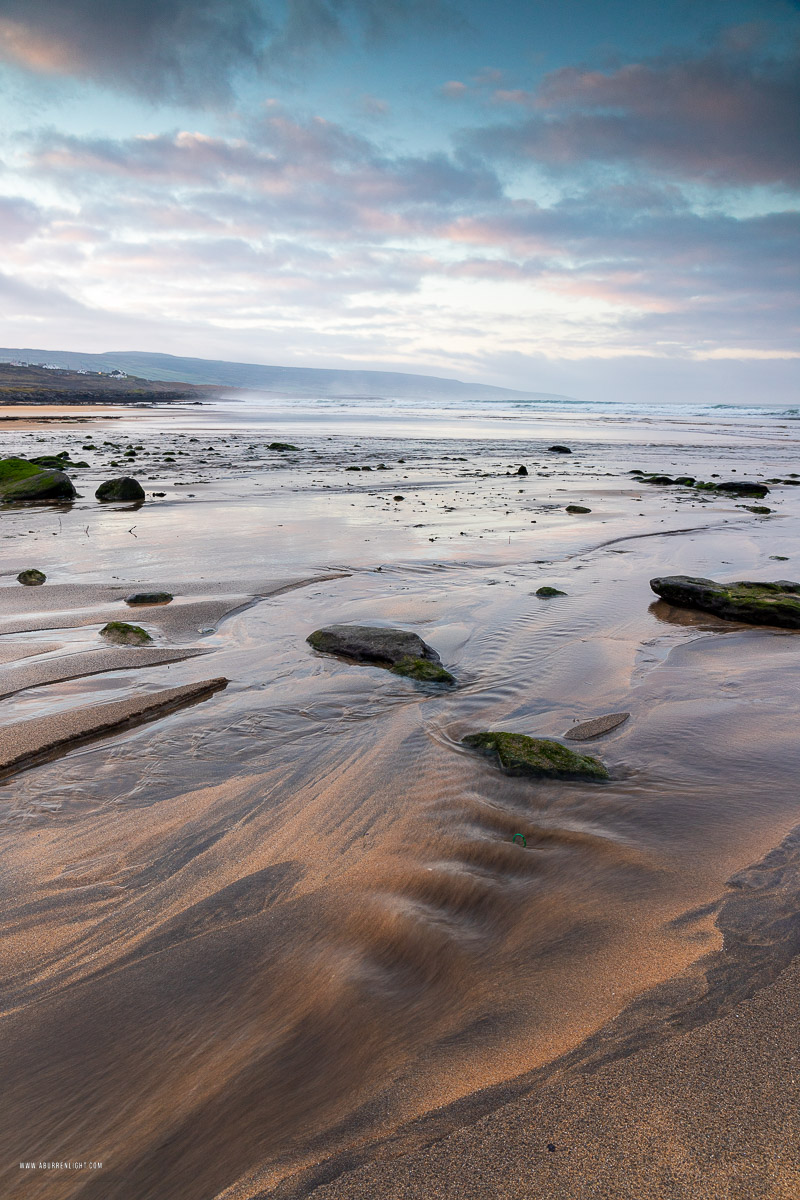
I have visited Fanore in all kind of weather. From sun splitting stone days without a drop of wind, to the most ferocious winter storms with a red warning and wind gusts to throw you off balance. The settings are equally impressive, but for different reasons! I love Fanore beach as it is the only beach in the Burren boasting such beautiful golden sand together with wonderful rock formations of clints and grykes as well as some of the most intricate stone erosion work I've seen to date on either side of it - so intricate that I like to compare it to a form of lace! Tidal water recedes leaving the most wonderful rill marks, tidal pools form around rocks, sand ripples abound all offering great foreground opportunities.
In addition, the river Caher coming down from the Burren hills finds a way through the sand dunes to end up in the ocean. It meanders down, leaving stunning shapes as it carves it way through the beautiful sand. These are the ones I used here in this shot, looking south west towards dwellings disseminated along the coast.
Fanore is a huge playground for landscape photographers. Literally, just get there an explore! I tend to prefer spring and summer times as the sun rises above the ocean as opposed to behind the hills, giving more opportunities for a great sunrise with better light, but it's really a matter of preference and of what your goal is going to be. Pack a ultra wide angle for those water pools and rill marks, and a macro lens for abstract close ups. Discover Fanore
Ballyreane, the winding road to Doolin
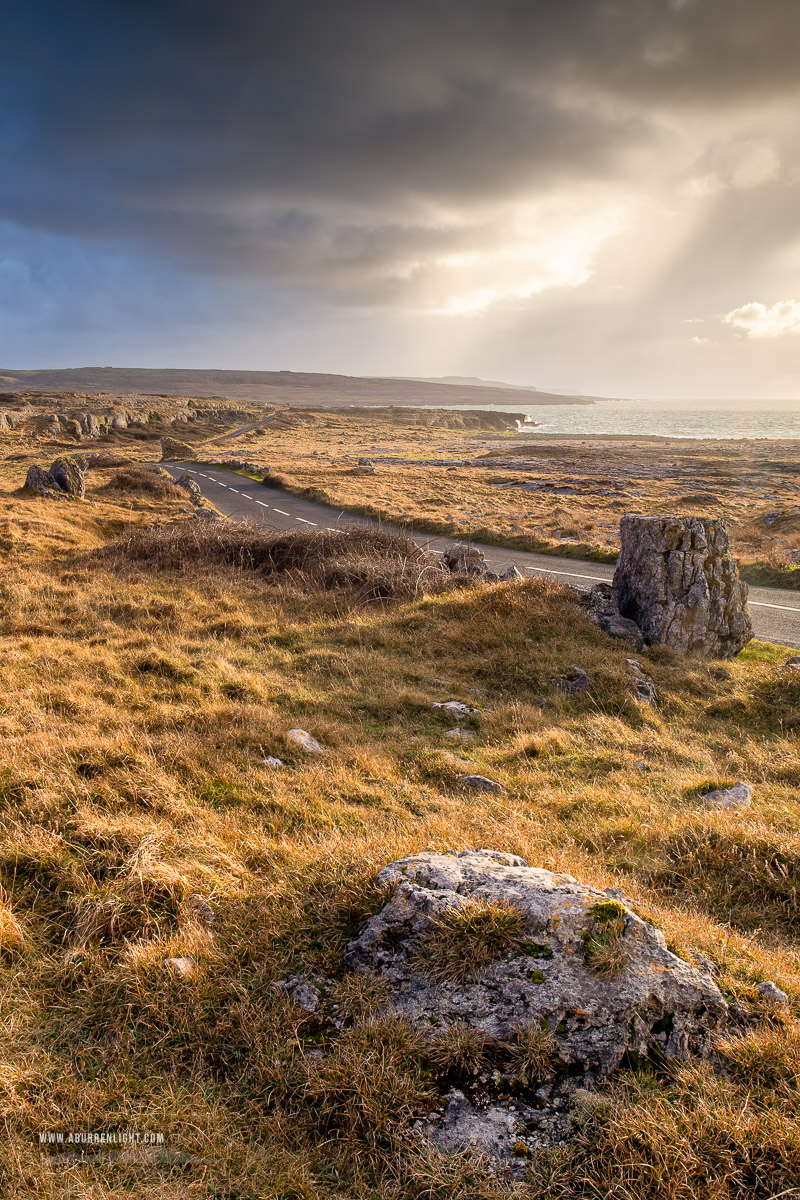
Aside of the majestic cliffs of Moher there aren't that many locations in the Burren that left me speechless on first sight. I was driving from Fanore and along the coast, and it's around a curve going up a small hill with a rocky promontory on the side, hiding what's beyond, that it hits you. The sense of scale is outstanding, the road winding through the landscape, hilltops on the left hand side, erratics and cliffs on the right handside, with a sight of further and higher cliffs farther south. On a great clear day, you can see the cliffs of Moher in the distance which is a nice addition to a stunning scenery
On such scale there obviously are countless opportunities. You could park on the road side shortly after passing the curve, and capture the sheer size of Ballyreane with the long winding road leading your composition, or venture on the hilltops or along the coastal drops to catch some nice coastal views with the telephoto.
Another thing I look forward to at every occasion is drive further and stop before a rugged cove, you'll see it as you drive along and there is ample car park on the left. On a stormy day, waves are quite impressive and a good telephoto will feel right at home.
Doonagore, medieval sentinel over the Atlantic
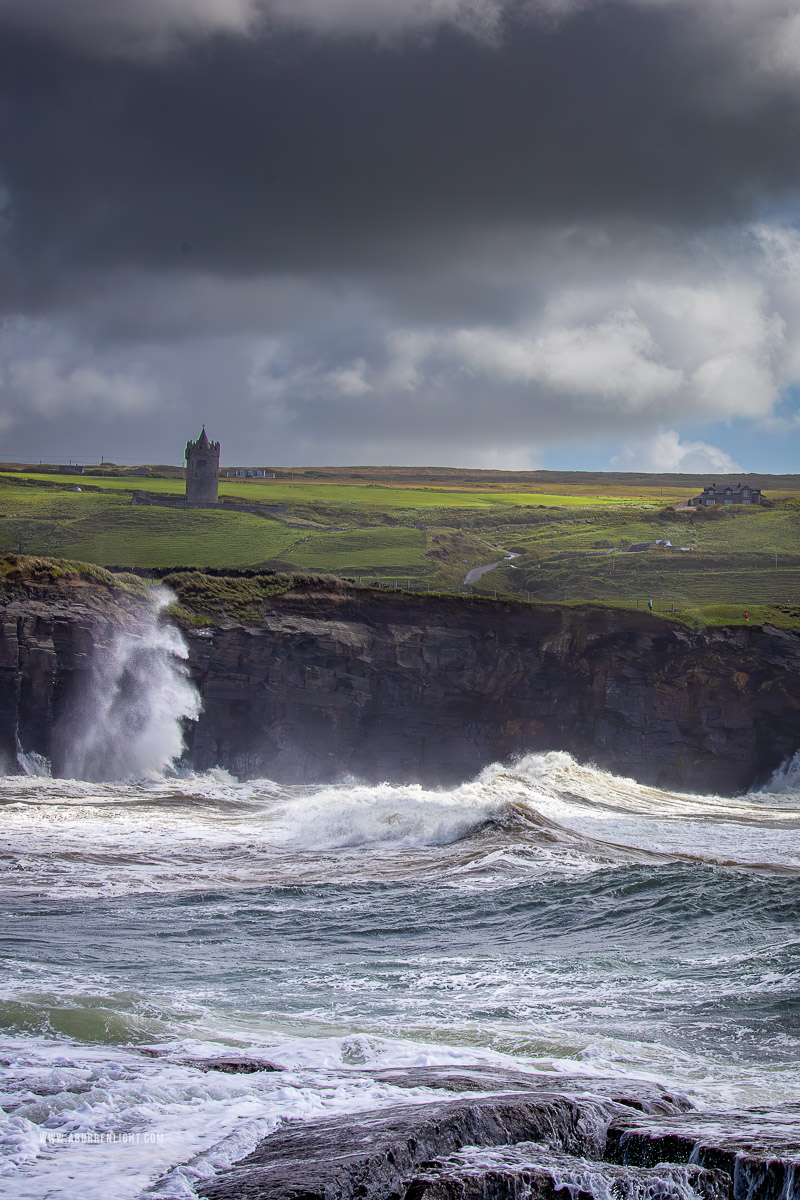
Doonagore Castle rises above Doolin like a lonely Atlantic sentinel, weathering centuries of storms and stories along this very touristic stretch of the Clare coastline. Built during the 16th century as a fortified tower house of the O’Brien clan, the castle still watches over the surrounding green fields and distant ocean exactly as it once did when ships crossed these dangerous western waters.
I always find Doonagore at its most photogenic during spring and autumn evenings, when the softer Atlantic light gives shape and depth to the stone against the wild Burren landscape. Sunset works particularly well here, especially when the sun begins dropping westward somewhere behind the castle, creating dramatic side-light and long shadows across the hillside. A telephoto lens around 70-200mm can isolate the tower beautifully against the distant cliffs, hills and ocean haze, while a wider lens allows the castle to sit naturally within the rolling landscape surrounding Doolin.
Low cloud, passing rain showers and fast-moving skies often create the most atmospheric conditions of all, giving Doonagore the timeless character it deserves.
The cliffs of Moher coastal trail
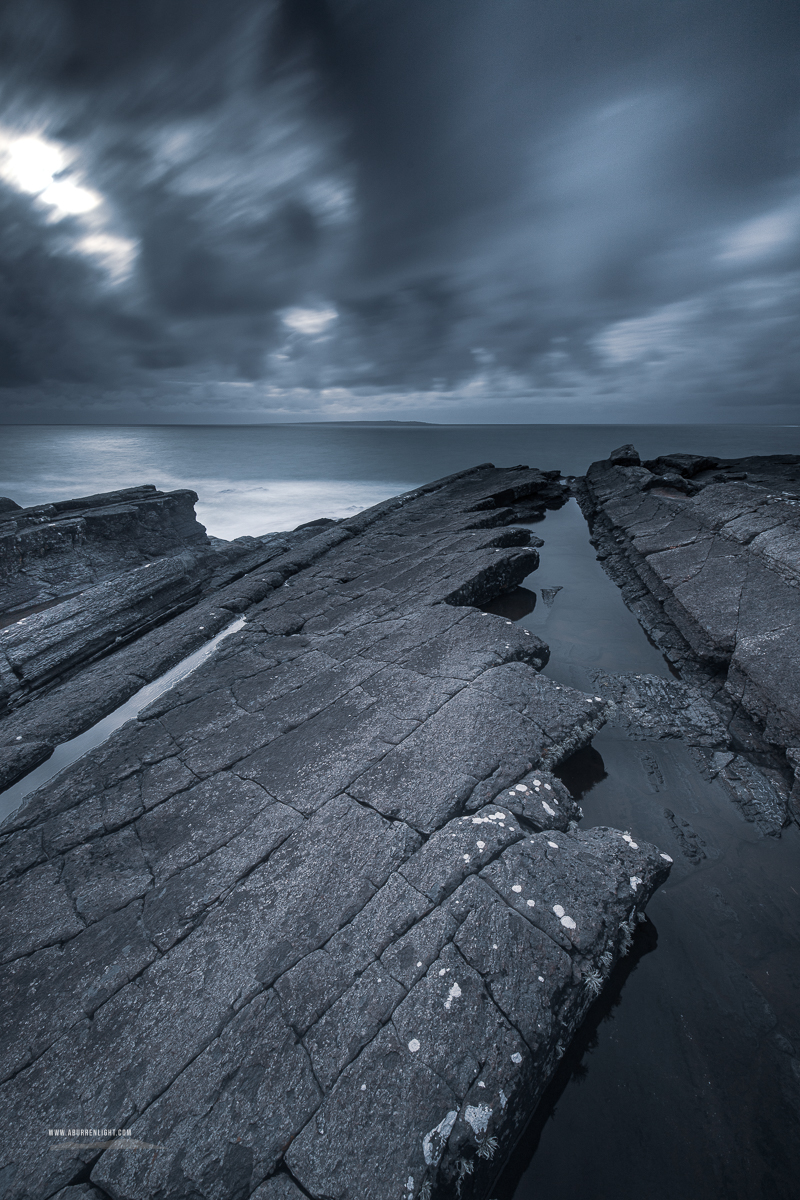
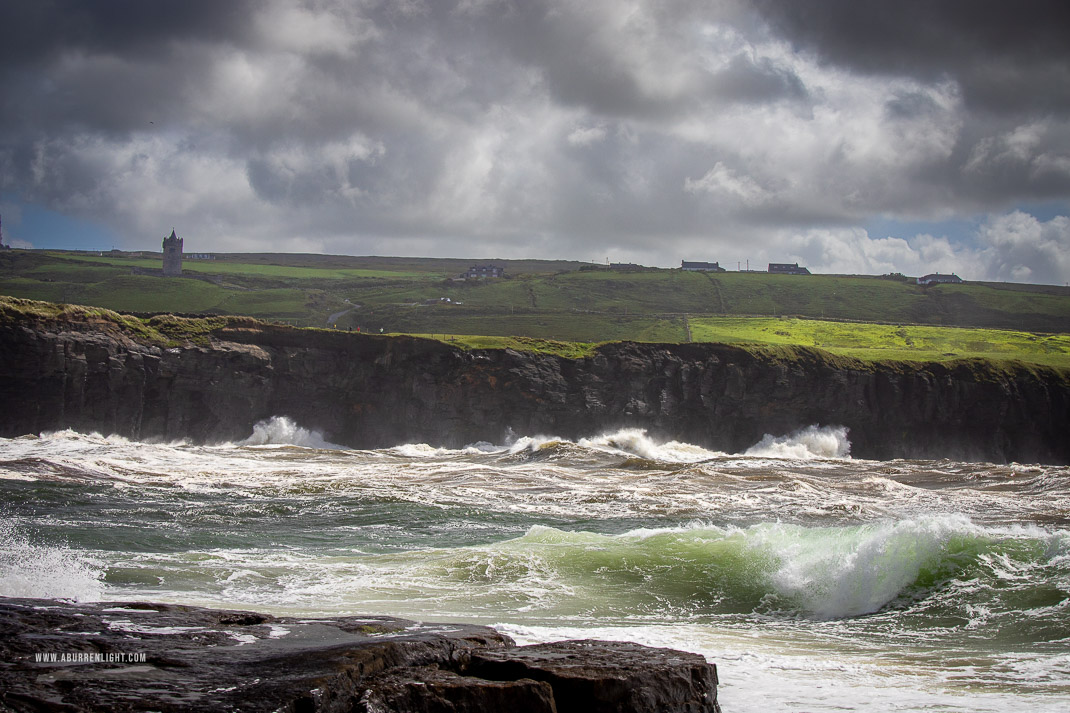
The opening section of the Cliffs of Moher coastal walk from Doolin can feel surprisingly exposed to the Atlantic swells, especially during unsettled evenings when fast-moving weather systems sweep across the Burren coastline. I captured this image as heavy clouds rapidly approached from behind, using a long exposure and ultra wide-angle lens to emphasise both the movement in the sky and the fractured limestone formations leading toward the distant horizon. A long exposure always manages to absorb and amplify that little bit of light present in the moment.
These rocky foregrounds, shaped over countless centuries by Atlantic wind and sea, create powerful natural leading lines for photography, particularly during blue hour or just before sunset when softer side-light reveals texture across the stone. Spring and autumn often provide the most dramatic conditions along this section of the trail, where rapidly changing weather, passing rain showers and low cloud can transform an already beautiful coastal walk into something far more atmospheric and elemental.
This is usually as far as I go, always leaving the magnificent cliffs 'for another time', perhaps also because I fear not doing them justice! One of those days and with a bit of guidance, I hope to venture down to their base to frame them with boulders in foreground.
The might of Atlantic storms
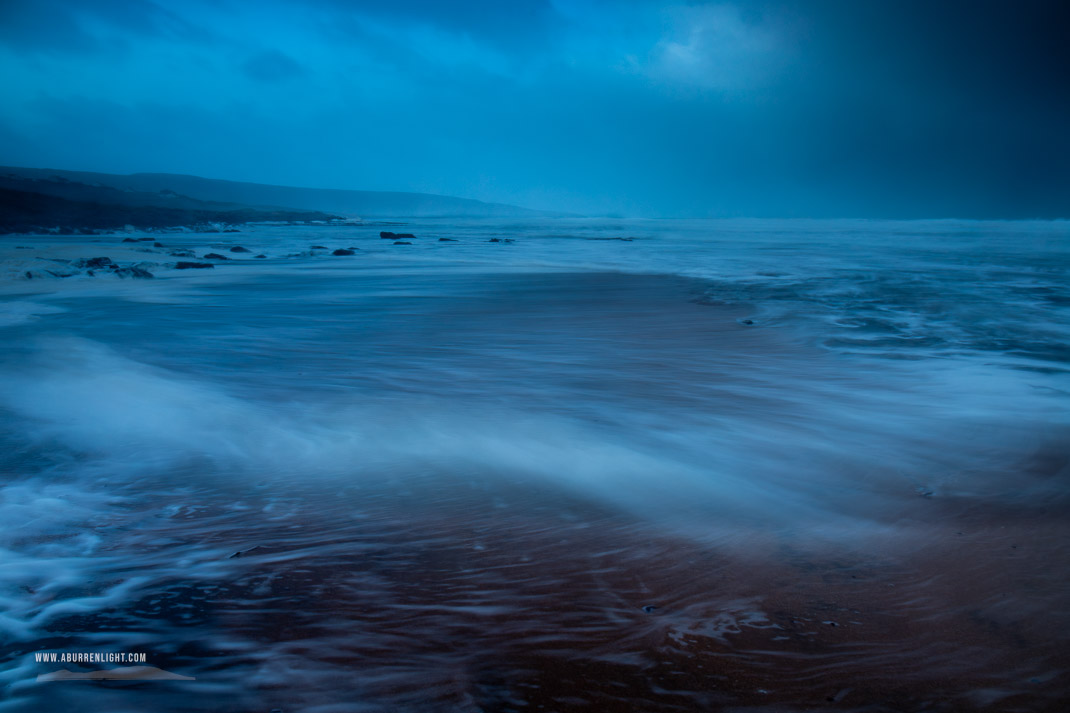
It wouldn't be right to end this article without mentioning the storms. What most surprises me with those storms, being a native of a much calmer (and sunnier) south of France, is the surge. The wind is extraordinary for sure, it takes a lot of determination to keep that tripod stable. But the surge, is something else. That February day when I hit Fanore beach to shoot storm Dennis, I was not expecting to find much of the beach under water.
The light was low, the roar of the wind with the additional super strong gusts quite deafening, still I decided to set the tripod, holding myself to it really, and shoot... With diverted attention, I did not realise that the sky went near black and a bolt of fork lightning hit the water ahead of me, making me quickly think that holding a metal tripod with my feet in the water during a storm, was by far not the best idea I ever had!
This concludes an overview of the South Burren coastline along the Wild Atlantic Way. I hope this article gave a few ideas to slow down, explore beyond the better-known viewpoints, and perhaps head out with a camera when the Atlantic weather begins rolling in. What makes this stretch of the Burren coastline so memorable is not necessarily the dramatic landmarks we can find on the North Burren coastline, but rather the raw and elemental character of the landscape itself. Here, limestone shelves meet restless seas beneath fast-moving skies, and the constantly changing Atlantic conditions shape how each place is experienced and photographed. Always be careful when walking on those slippery clints! The Atlantic swells and tide can also take anyone by surprise. Have fun, and be safe!
Discover the guide to the North Burren Coastline — Castles and Towers, from Black Head to Kinvara.
Discover the photography collection! Portfolio and Limited Editions fine art prints selling & shipping worldwide.
Following on related topics, some visual pages to bring you deeper into the Burren Light & Land project: