Photography GuidesMarch 24, 2026– 11 min read
The Burren Lowlands, County Clare — A Landscape of Stone, Pastures, Water and Light
A story posted in the Burren Stories, a section of the The Burren Light & Landphotography project. New to the Burren? Start here.
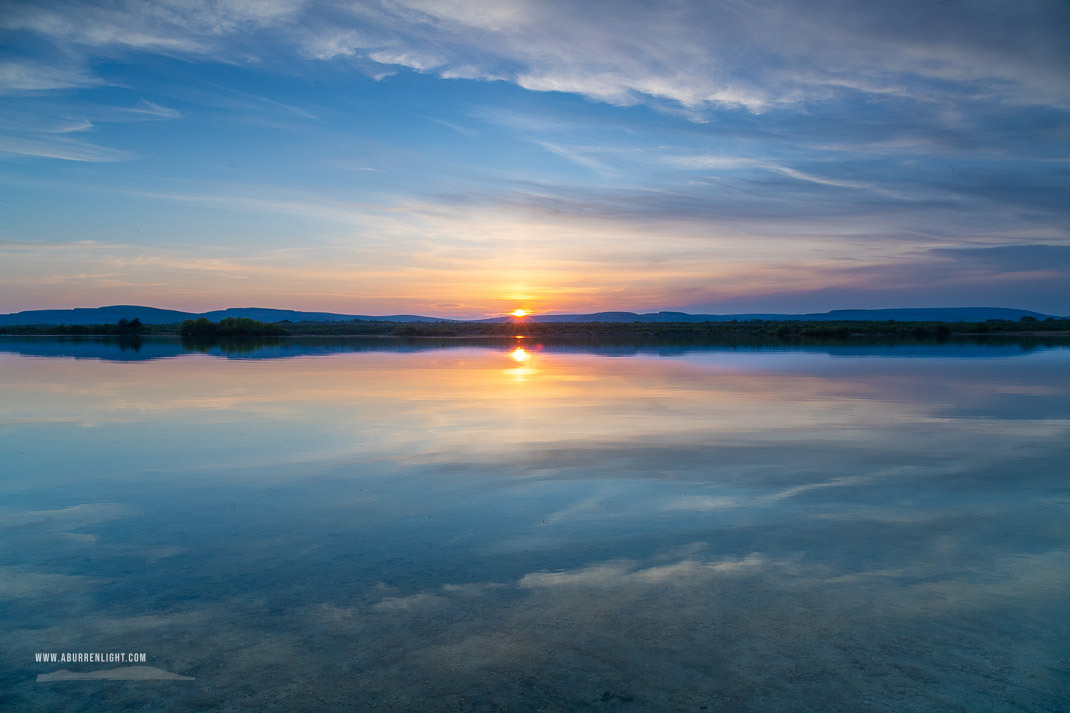
The Burren lowlands in County Clare offer an remarkable side of Irish landscape photography.
Where the Burren softens
There is a moment, driving north from Ballyvaughan into the last hills of the Burren, when the land changes. We are going over the ‘last’ Burren hills going North, their fractured limestone pavements are still present but loosen in places as we drive away from the hills, the ground lowers, and the horizon opens wide into something softer and more expansive. This is the Burren lowlands in County Clare, part of one of Ireland’s most distinctive landscapes. Stretching gently between Gort and Kilfenora, these lowlands form a natural transition between cultivated land and the stark, exposed karst of the central Burren. Limestone remains ever-present, shaping the ground beneath your feet, but here it shares space with grassland and pastures, loughs and turloughs and wide, open skies.
For photographers, it is not a landscape that immediately imposes itself. Instead, it reveals its character slowly, rewarding frequent visits, time, attention, and a willingness to look beyond the obvious. In this article, we will look at a few location which make our lowlands so special. This is by far not exhaustive! I will present additional locations in future articles as part of the stories and experiences.
The rocky plateaus, so Burren!
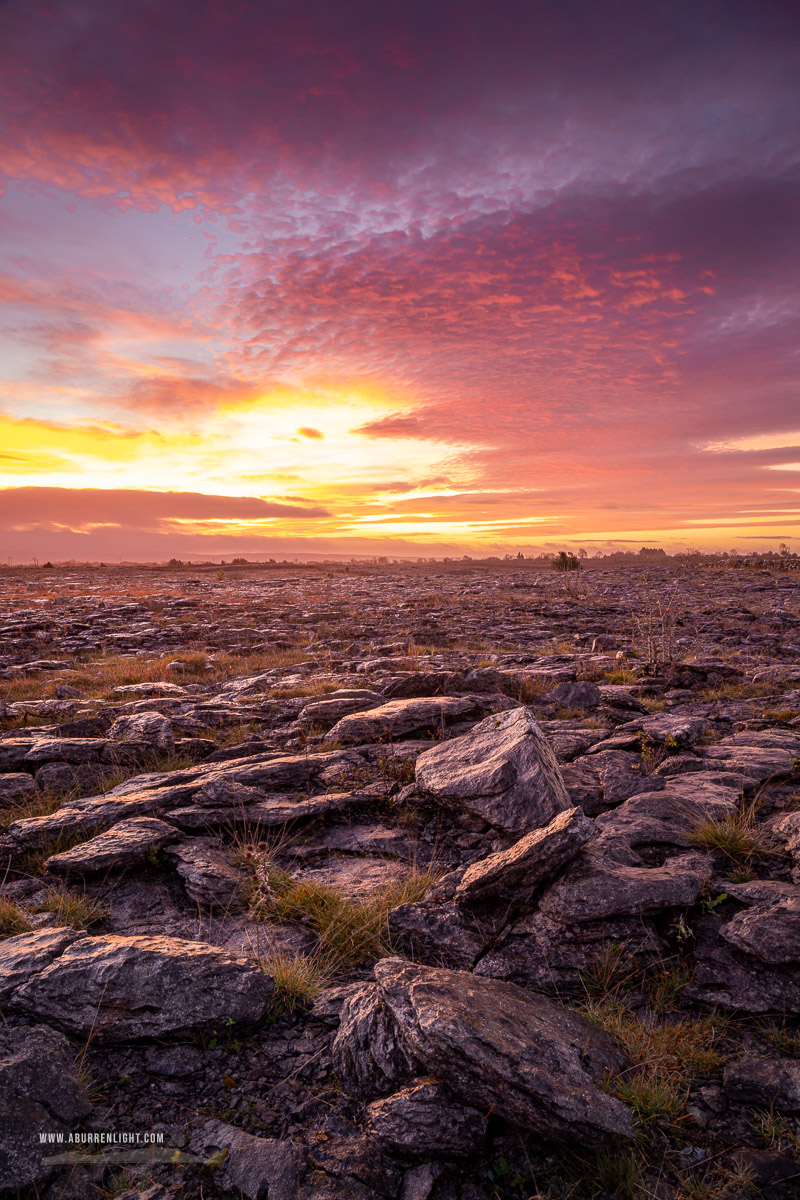
The rocky plateaus of the Burren lowlands carry a complexity that only reveals itself with time. What appears at first as scattered stone is, in fact, part of a vast limestone pavement, shaped over thousands of years by glacial movement and the slow, persistent action of rain.
The surface is broken into natural slabs, known as clints, separated by deep fissures called grykes, creating a subtle, irregular geometry that runs across the land . In the lowlands, this structure often softens, with grass and thin soil weaving between the stone, but the underlying pattern remains, guiding both water and light.
For photography, this rocky ground offers more than foreground interest; it provides rhythm, leading lines, and a tactile quality that draws the viewer into the scene. With spring, grykes and grassland thrive with life, orchids and other native flowers bloom offering patchworks of colours, a welcome change to the rocky foregrounds! What I also love is finding an ancient root for foreground, or a patch of golden grass towards the end of autumn, when colours really peak.
The pastures of the Burren lowlands
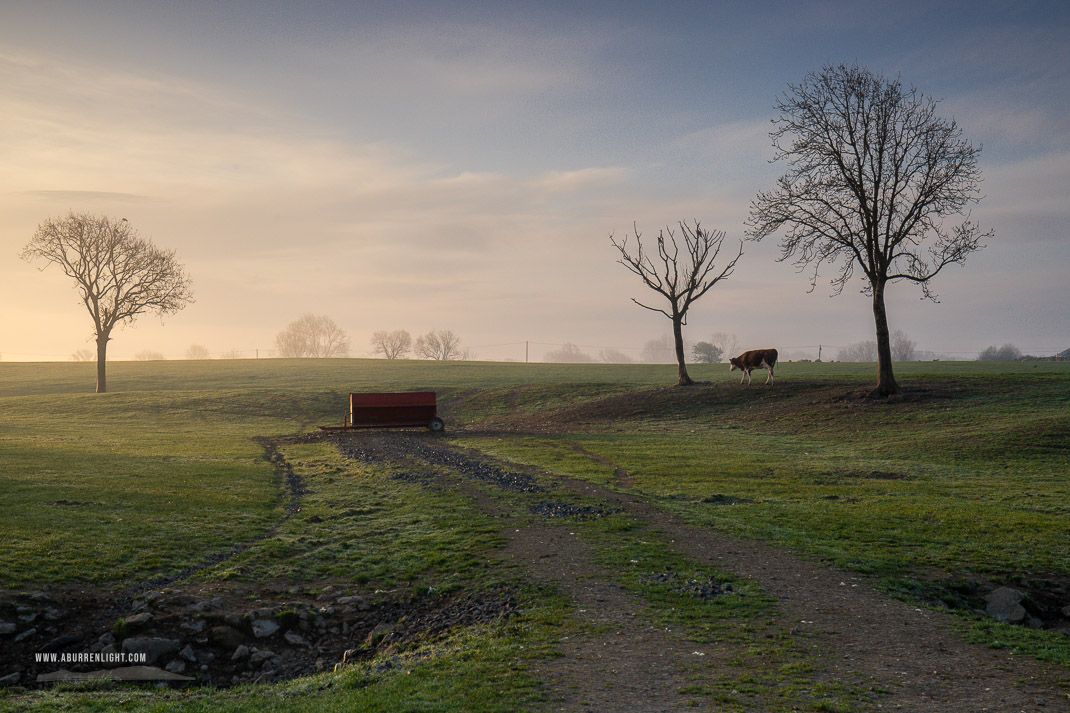
Across the Burren lowlands, pastureland spreads gently, softening the landscape. In some areas where limestone abounds, you'd be pressed to find any patch of green whereas in others, it is lush from the start of April onward. Generations of farming have learned to work with the land rather than against it. Thin soils rest lightly above the rock, enriched over time, allowing grasses and wildflowers to take hold. Stone walls divide fields in irregular lines that echo the underlying rocky terrain.
For photography, these pastures offer a gentle counterpoint to the harder textures of the Burren, introducing softness, easing a sense of scale that grounds the wider landscape. I love to look for patches of grass spread here and there across the rocky plateaus as this is where, from the start of spring, I would usually find the early orchids, the red valerian and blue gentian which all look fabulous as foreground. Look for those in April and May, with the valerian a little later in the picture. As we go further into the west, the fields growing in size expand into the horizon: gentle pastures dotted with sheep and cattle, which I love to photograph as well!
More pastoral photography here .
The lone trees, photographic 'heroes' of the lowlands
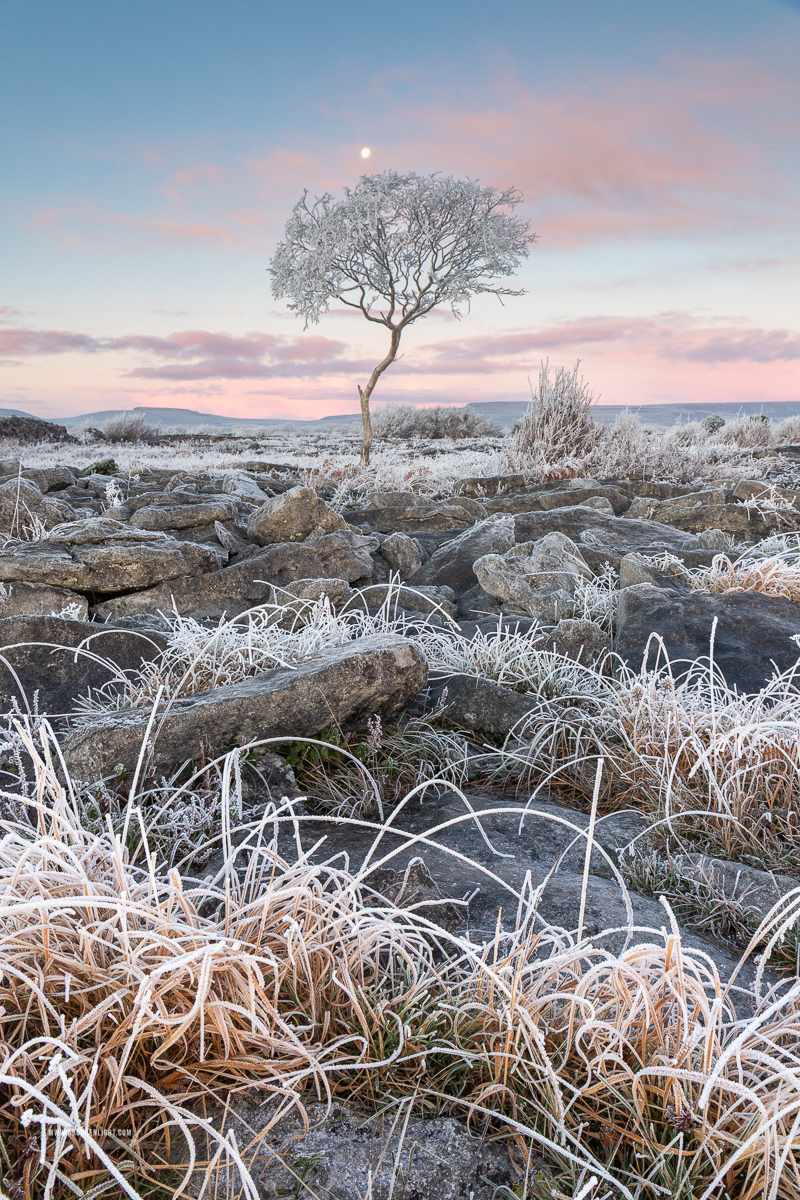
Perhaps what first drew me to the lowlands, on early discovery drives to find photo opportunities in the Burren, were lone trees. You can find those all over the Burren for sure! But in the lowlands vast expanses of stone, these are a true blessing for landscape photography: it would just be that much harder to find other composition anchors! Lone trees appear scattered across the rocky plains, standing defiant of the thin soils and the exposed conditions. They seem shaped as much by the wind as by time itself, rarely growing tall, instead forming subtle, irregular silhouettes that sit within the land.
As they stand alone, they offer a photographic opportunity that is quite rare in the lowlands. There are no dense woodlands or competing elements to complicate a composition; instead, each tree becomes a natural focal point, helping balance the surrounding 'emptiness' in a photograph. In mist, they reduce to simple forms against their background. In low evening light and particularly in winter, they stretch long shadows across the limestone and grass, adding direction and depth to your photos. Beneath a changing sky, they anchor a frame, giving scale to the openness around them.
In these moments which I am fortunate to have entirely to myself, with hardly anyone to share the experience, the photograph becomes for me less about the tree itself and more about its relationship with the land, the light, and the space around it. I have shot them from a few feet to fill in the frame at first. now I love to take some distance and include them in my composition along with other of the elements that make a Burren landscape so captivating: the gnarly roots, the golden tall grass, the beautiful wildflowers.
The lone trees of the Burren.
Lough Bunny, star of the Burren loughs
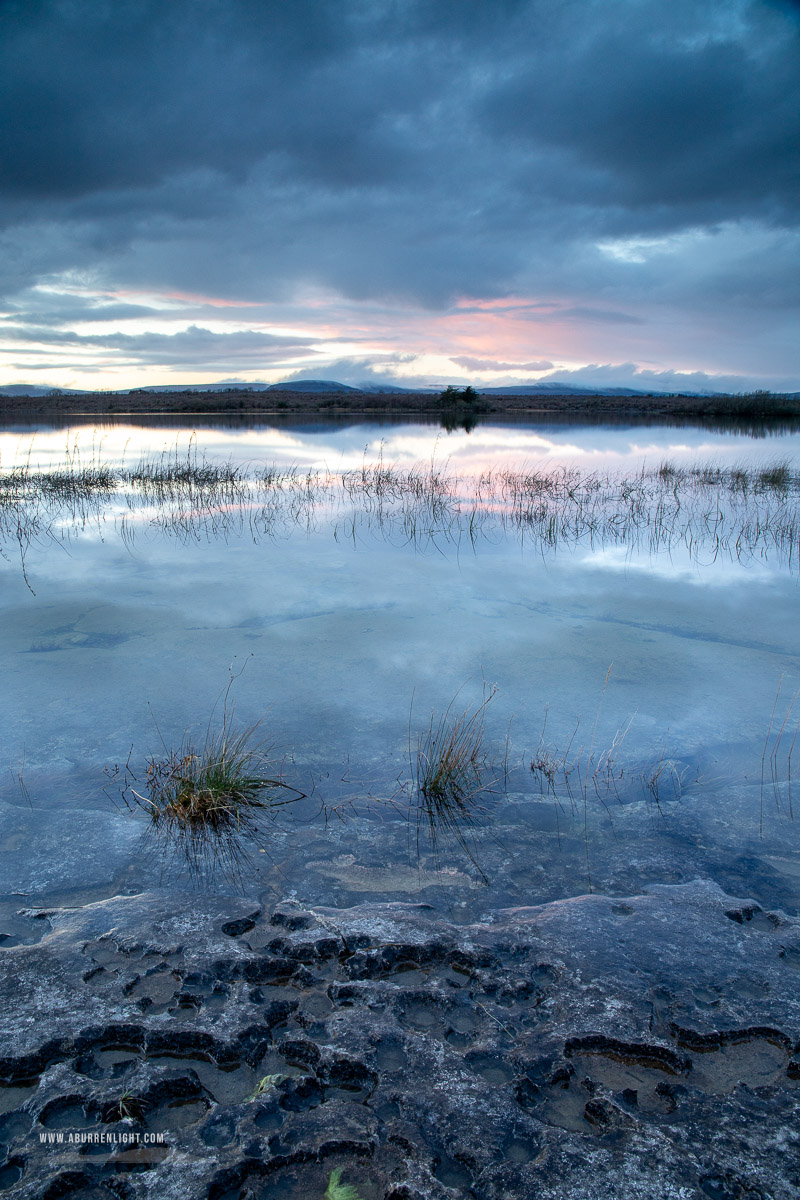
Among the many features of the Burren lowlands are the loughs and turloughs. Lough Bunny, modest in scale, is perfectly positioned within the Burren landscape, with a rocky plateau to the east and the string of Burren Hills to the west. It was my 'pressure safety valve' during Covid, I never missed a colourful sunset, not leaving too far I could anticipate the changes. More often than not, I had the place all to myself, most of the time. The lough's name is believed to derive from the Irish Loch Buanaí, a term associated with endurance or permanence, which feels fitting for a place that carries a sense of timelessness. Just as the rest of the Burren, it's one of those place that seems to be in its own time capsule, away from the hussle and bussle of civilisation. Except perhaps on those very few evenings in summer, when the day is warm and local people flock to it for a dip in.
It's also in the summer that the lough becomes particularly compelling for sunset photography, as the sun travels far to the northwest and the lough and lowlands provide an uninterrupted view of its descent. The light stretches across the water as the sun sets behind the hills. One of my favourite is to look around the lough to find some foreground interest, whether a stone of a little sapling. On still evenings, the surface of the lake reflects the sky with remarkable clarity. The lough rewards patience and careful observation! I've had the best evening there catching the very last of light, subliming the water reflection with long photograhy exposures.
More photography: Lough Bunny .
The Scots pines at Rockforest
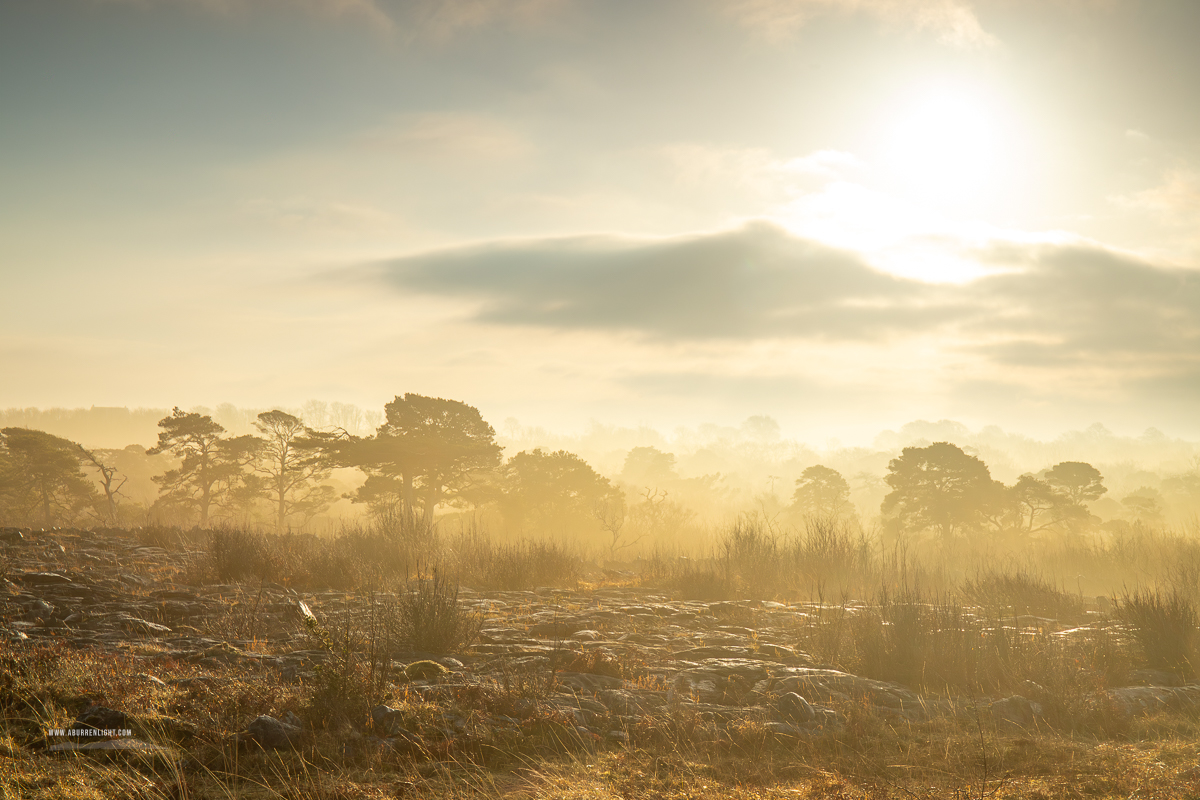
To the east of the lowlands, Rockforest offers a glimpse into both the past and the future of the Burren. This area is significant for its connection to native Scots pines, which once formed part of Ireland’s post-glacial woodland but gradually disappeared over centuries. Farming and construction seems to have been the main denominators to the pines demise! Evidence of their presence still remain in the land, preserved through pollen records and ecological traces, suggesting a landscape that once held more vertical structure than we see today, though I like to think the 'survivors' are still around as they grow in less favourable areas for farming.
In recent years, conservation efforts have begun to reintroduce these native trees to Rockforest, not as plantations, but as a careful restoration of a lost element of the ecosystem. Their return will slowly but surely transform the visual character of the area, as their tall, lightly structured forms will rise above the limestone, filtering light, introducing depth.
It is quite a secret location and hard to find I have to say! I was quite happy when I finally found the Scots pines. For a Burren photographer, they offer new compositional possibilities, bringing layering and contrast to a landscape that is often defined by horizontality. More than that, they suggest a continuity within the Burren, a sense that the landscape is capable of remembering, renewing itself over time.
Rockvale, Boston
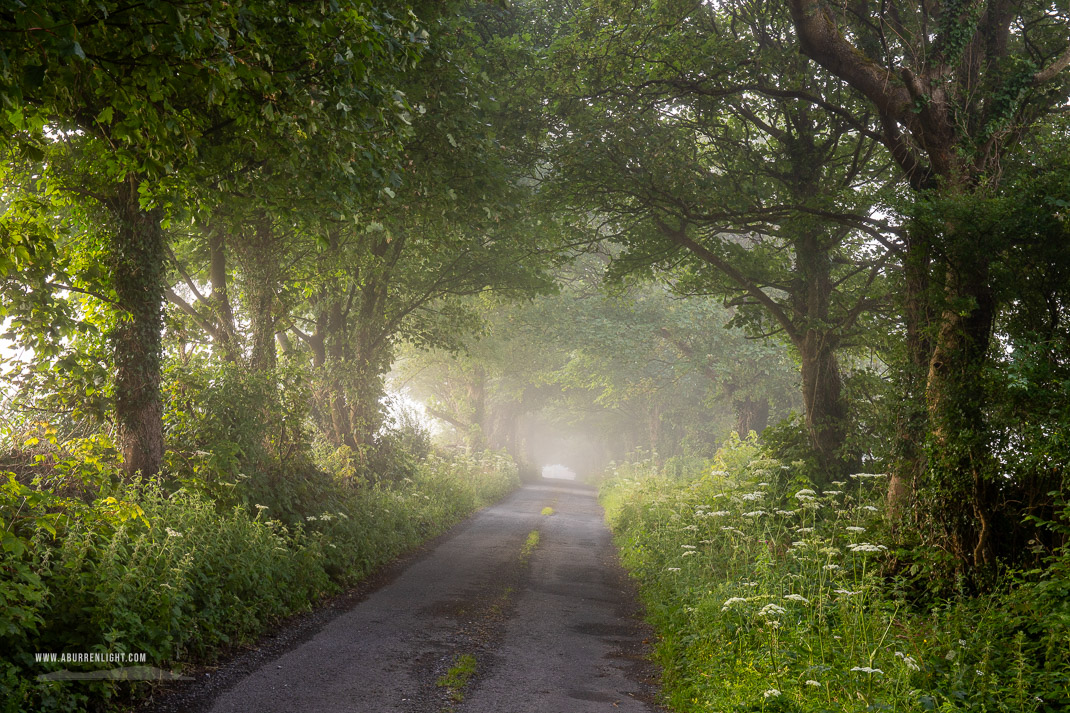
There is that wee stretch of road between the R460 and Boston that will grab your attention. In spring the leaves take over with lush greens all around and on a misty winter morning, it feels as uninviting as the entrance to Shelob's lair, the giant spider in Lord of the Rings. Don't forget your telephoto lens! This shot used a wide angle lens but a telephoto will compress the perspective for some really interesting photographic compositions.
Down the other end of the road from the main road to Corofin, you will find the Cloondooan tower. Boston is a small, historic village in the East Burren, County Clare, nestled near Lough Bunny and surrounded by karst limestone pavements. Once populated by thousands pre-Famine, it now serves as a quiet farming community, featuring a 350-year-old church and nearby Cloondooan, known for a three-month siege in the 1550s.
Flowers in the grykes and grassland
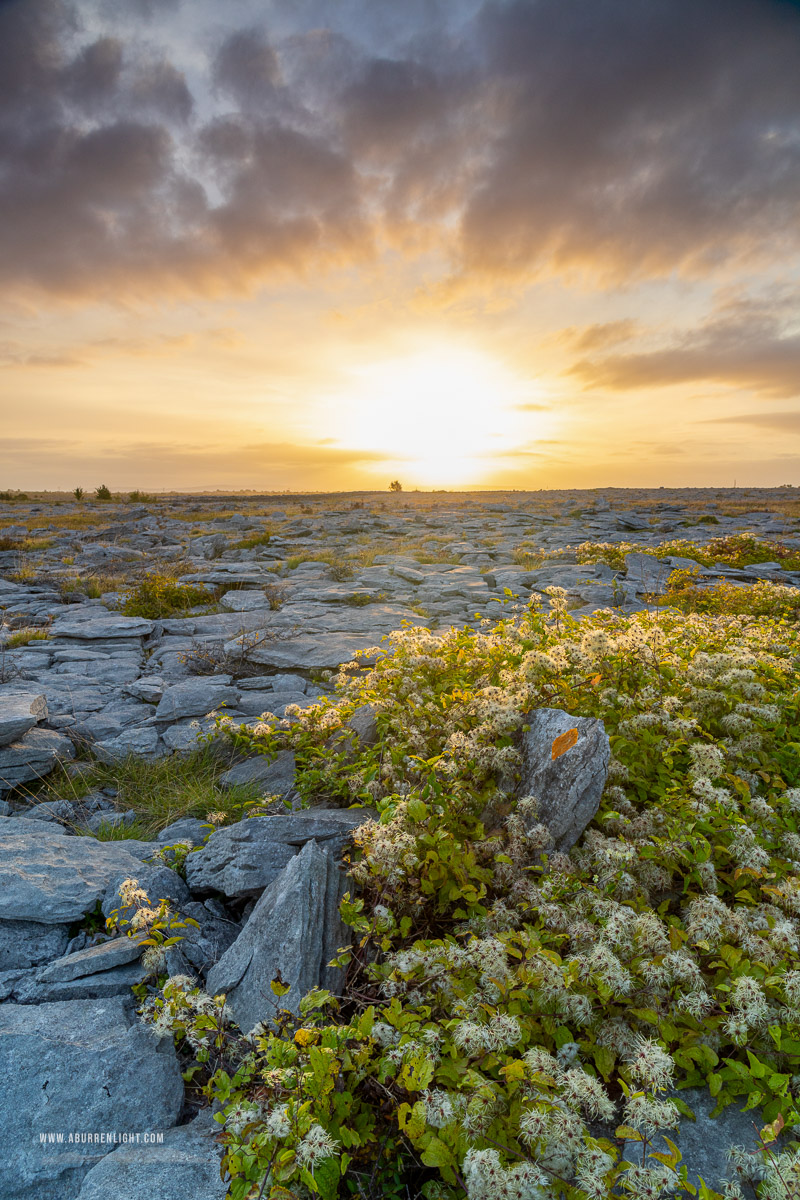
Despite its apparent austerity, the Burren is one of the richest botanical landscapes in Ireland, and this is especially evident when looking closely at the limestone itself. The grykes, deep fissures that cut through the rock, create sheltered environments where soil, moisture, and protection from wind combine to support a remarkable diversity of plant life. Within these narrow spaces, species more commonly associated with vastly different climates grow side by side, including Arctic-alpine plants and those typical of Mediterranean regions.
In the lowlands, this richness extends beyond the pavements into surrounding grasslands, where seasonal changes bring subtle but intricate displays of colour. Orchids, gentians, mountain avens, and cranesbill emerge from what at first appears to be bare stone, while ferns and mosses line the shaded crevices. It's particularly obvious at Morroughtoohy, a set of rocky plateaus stretching to the ocean, although flowers bloom everywhere in the Burren!
For a photographer, this invites a shift in perspective, from wide, open compositions to intimate studies of detail, texture, and light. We can also use flowers as foreground pretty much everywhere around the Burren lowlands and hills as they equally thrive there, whether it be along the 'new road' or on the slopes of Abbey Hill.
Enjoy some Burren bloom photography.
Be careful and considerate!
Wild flowers may not grow back once their stem is crushed, make sure to proceed with care particularly in the grassland as tall grass can hide some beautiful flowers. It's also always good to minimize your 'footprint', if only for the enjoyment of others. Do not pick wildflowers, they really do make the place beautiful and will eventually die in a pot.
Finally, pretty much the whole of the Burren lowlands are private, and may be home to livestock. Whether you photograph or not and are just on a ramble, always be respectful and aware of your surroundings, particularly if you walk with a dog - always on leach whether you see livestock or not. Unleash them only when you are sure they cannot cause distress to other animals. Sheep will break limbs trying to escape, protective cows will cause some real hurt if you get too close to their young. There are very few bulls also, but one is never too sure!
It is very hard to find out who owns a land and ask for permission, though most farmers you may come across will always make you feel welcome, as long as you respect the place and, most importantly, the livestock. I follow a strict rule: if I see livestock, I am just not going in, and will find another spot.
Discover the photography collection! Portfolio and Limited Editions fine art prints selling & shipping worldwide.
Following on related topics, some visual pages to bring you deeper into the Burren Light & Land project: