Monthly SeriesJune 23, 2026– 8 min read
The Burren in June: Daisies, Valerian and great twilights
A story posted in the Burren Stories, a section of the The Burren Light & Landphotography project. New to the Burren? Start here.
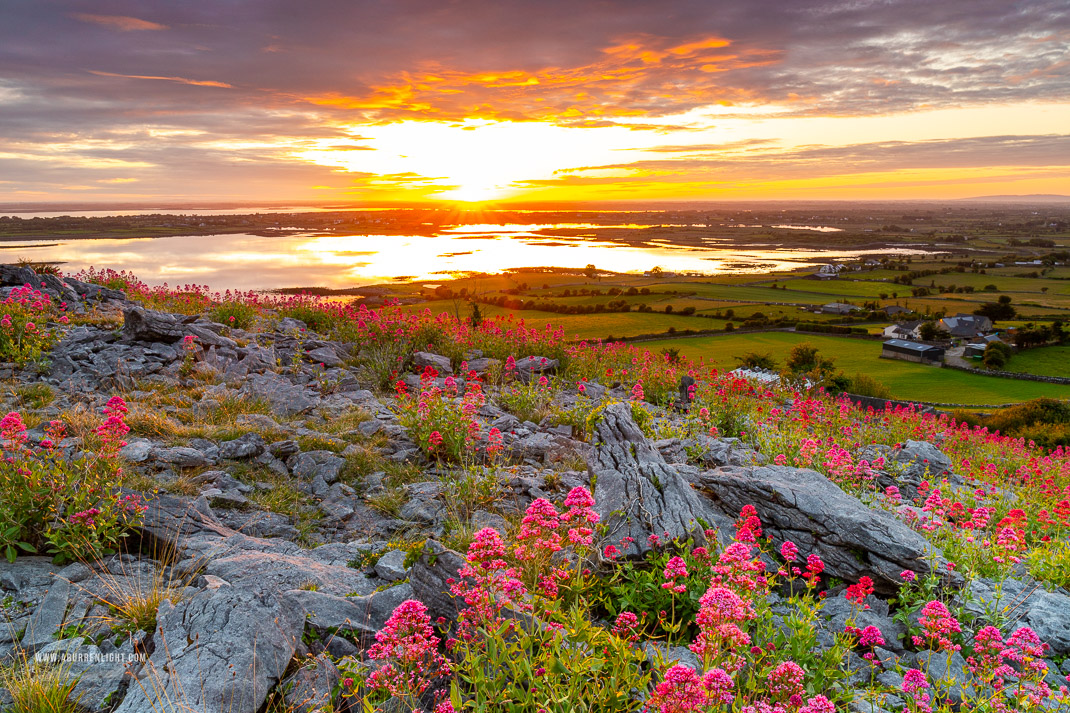
Some favourite locations in June
Dunguaire Castle in Kinvara
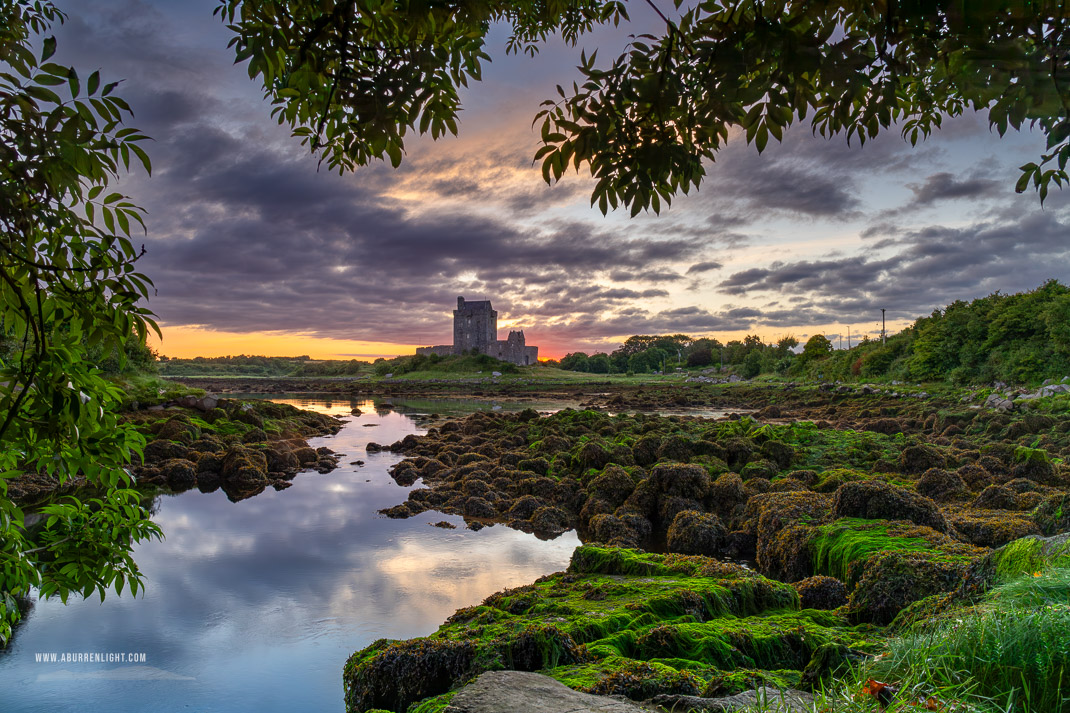
June is great for landscape photography around the Burren. There really aren't many locations I would avoid for sunrise except perhaps any hill slope facing south East, and for sunset as you would have guessed any viewpoint looking out west. Fahee North definitely is at a disadvantage!
The coast though, is fabulous, from sunrise to sunset, with great views over Dunguaire at sunrise as you can see here (note the almost fluorescent green algae at its best this time of the year).
June is also a month of high and very low tides. I tend to avoid low tides there as it just doesn't work for this location: I love a good castle reflection in the ocean water! Time it well: best at sunrise, mid to high tide.
The Flaggy Shore, New Quay
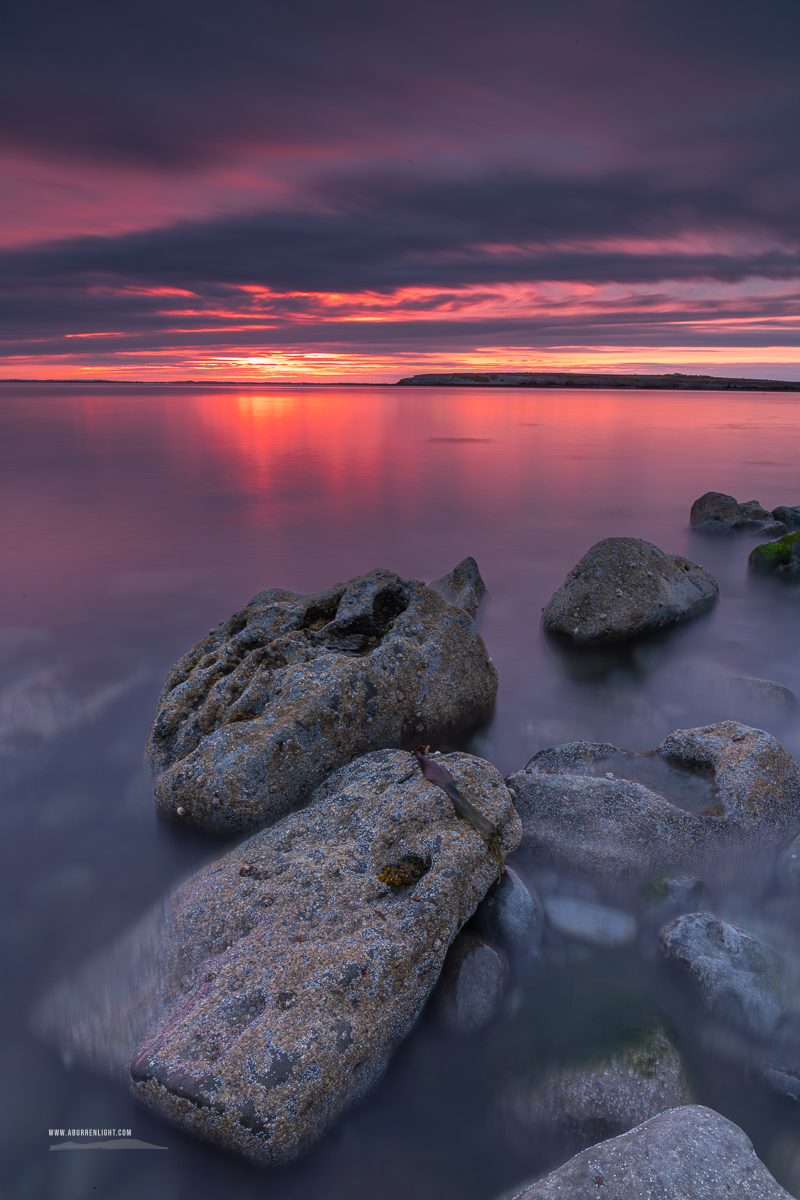
Not too far from Dunguaire yet dramatically different, the Flaggy Shore has a limestone coastline full of layered pavements, large pebbles and boulders, some of those covered with that vivid green filandrous algae making those foreground pop!
The land of the Aughinish peninsula stretching into the horizon has also great potential to scale your image. I love going there pre dawn but sunset works just as well from the other end of the Shore as the sun sets behind the Connemara skyline, which can be seen on a good clear day.
What's not to love in Flaggy Shore in June? Perhaps low tides! Lower water levels reveal banks of dark algae which are in great contrast with the softer grey and brown limestone pavements. I've tried many times to overcome this, the only way I could find was a lower to the ground composition. Aside of this, it's a great place for dazzling sunsets and mesmerizing dawns! Ensure you catch the sea thrifts at their prime, at the end of May and the start of June, they offer fantastic, colourful foregrounds to add to your limestone compositions. It's quite challenging to always have rocks to play with, I always see flowers as a refreshing arrival in spring!
Gorgeous sunsets and flower displays at Flaggy Shore .
Lough Bunny and its magical dusks
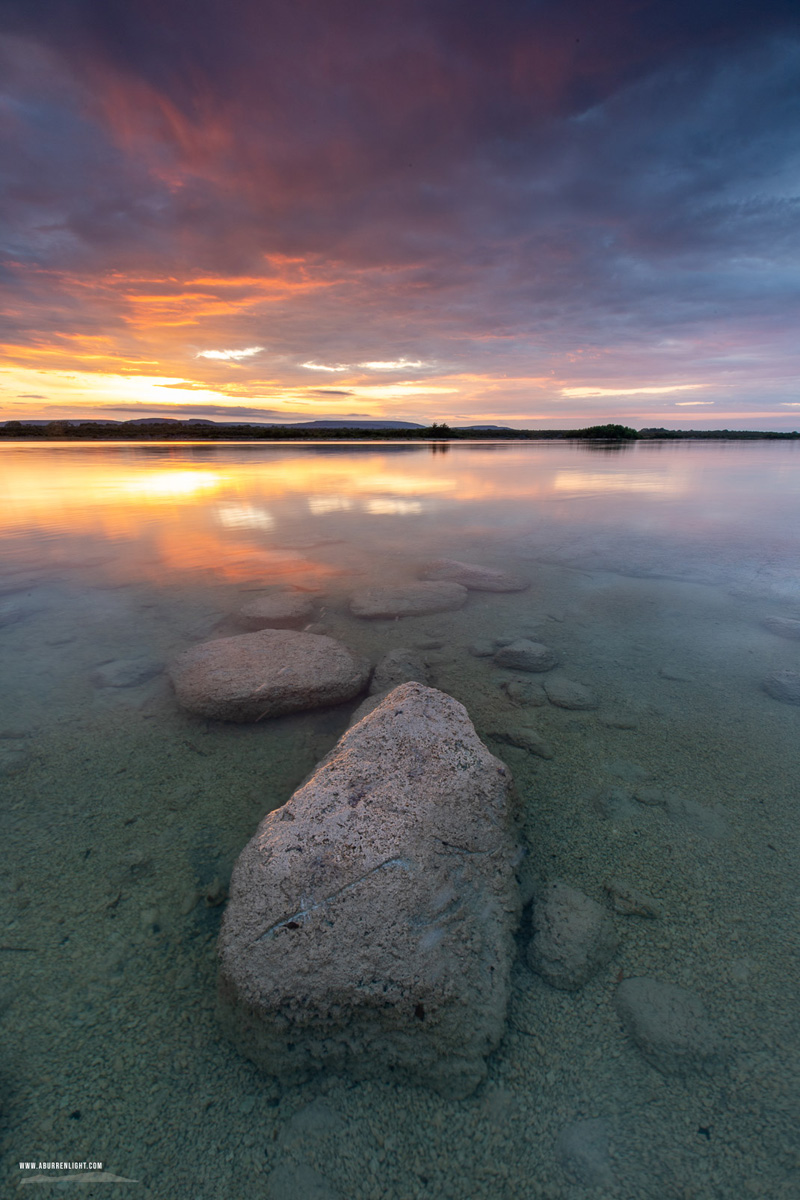
Lough Bunny is usually replenished by streams coming from Burren hills. In the summer months those usually dry up and the lough evaporates a great deal, which makes the lake very interesting for those shallow, clear water shots. What's even better the sun sets behind the Burren Hills and with that sometimes comes a splendid 'after burn' right after sunset.
June is particularly the best month to catch those as it's often a month with calmer waters (no much wind) and often a lot of high clouds. With a sun very slow to set, expect the longest after glows, lingering on for well over an hour!
There are a few access paths along the lake, some taken over by green growth (bring a hacksaw! hehe) but it's generally cleared by June. A few steps down will bring you to the shore with countless opportunities. Find some rock or a shrub, and wait for the light. With some luck the water is still, the water shallow. I choose not to use a polariser, I love to catch reflections, rocks and bed at the same time. A long exposure will amplify ambient light and reflection as you can see in this photograph. It is really rewarding, if only for the peace and silence you can find at the lake. Don't plan too much! You really never know when any good show of colour and light breaks through the clouds.
Favourite subjects
Red Valerian, beacons of light
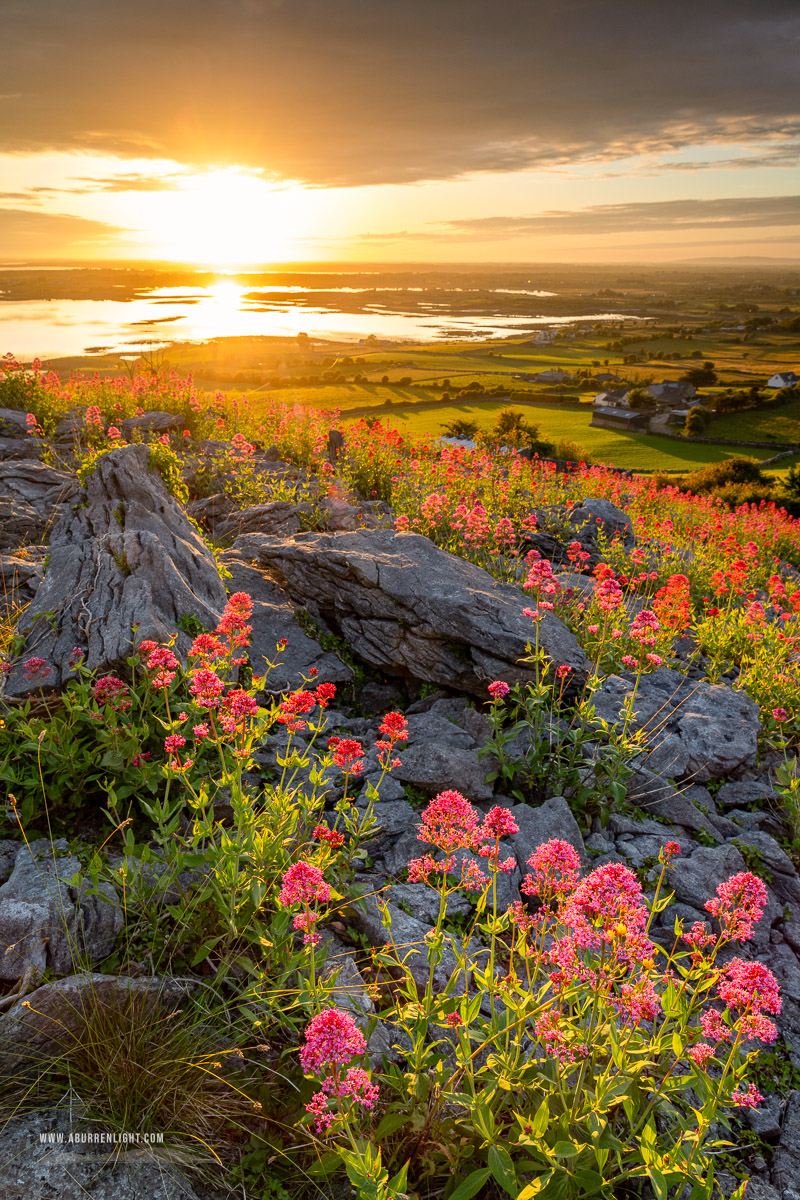
Any other time of the year, these little flower bombs will look deceptively boring. Very few leaves, dried hollow sticks rather than stems sticking out like sore thumbs, they really make it hard to love them for foreground, or anything else really! In despair I would often break those stems so they look 'presentable' and good enough for foreground. Towards the middle of May and well into June, they transform into those beautiful red bouquets all over Abbey Hill, across many of the lowland limestone pavements and along either sides of many country boreens.
Red Valerian is an alien, invasive species that thrives in the Burren because the dry, rocky limestone landscape closely mimics its native Mediterranean habitat. Originally introduced as a garden plant, it has spread aggressively across the karst limestone, where it poses a significant threat to the region's rare, native flora. We can find some of the less frequent white variety in place and particularly along the N67 coastal stretch from Sean Muckinish to Ballyvaughan.
There is not a June where I don't get up early to catch those at sunrise! You will find them an abundance along the L4507 a.k.a the 'new road' section, the older section between Roo and Cappacasheen in addition to the N67 mentioned earlier. I already have plans for other location shoots though as these carry on spreading.
To see more of those have a look at my valerian images .
Daisies and the grasslands
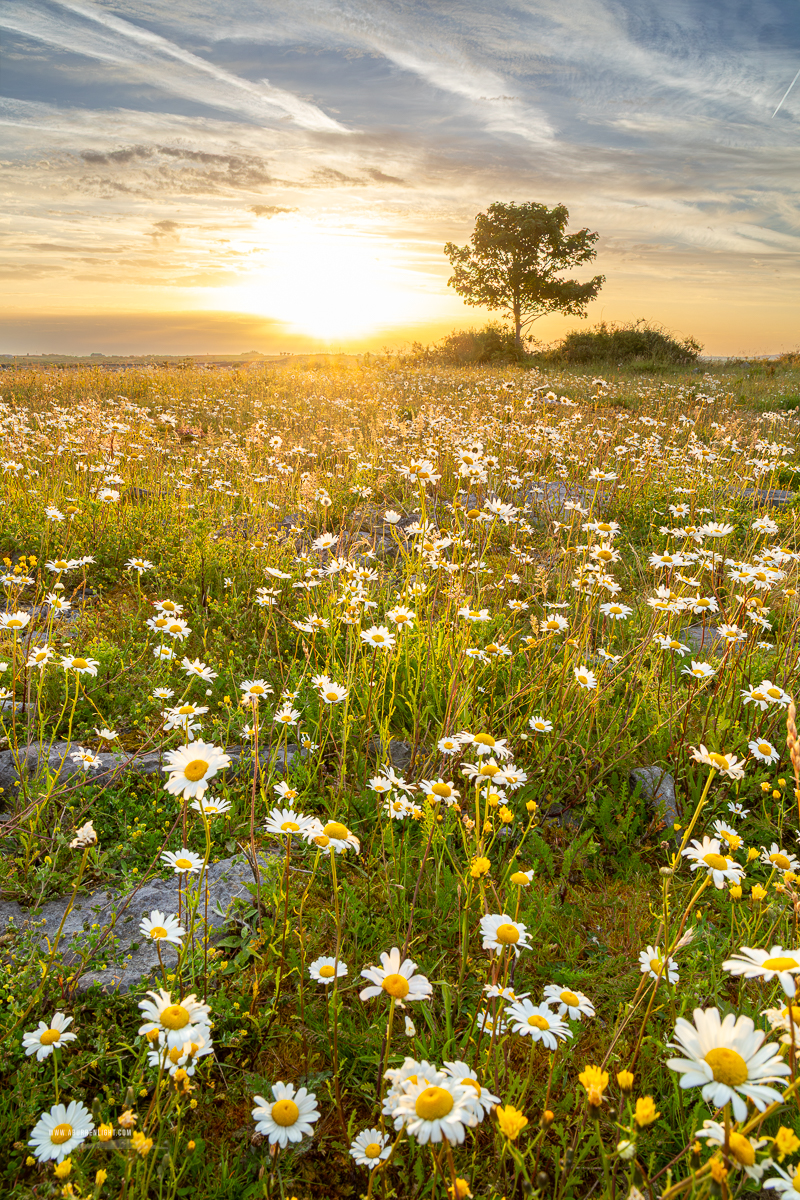
There is a fair amount of luck involved in capturing a great display of Oxeye daisies in the Burren. Amongst the limestone pavements and rocky meadonws, grassland is quite scarce. Whatever little there is is often grazed on by a herd of cattle, it's no surprise that chances of having a nice par terre of these tall, bright flowers are slim on any good year.
With this in mind, an observation game starts: towards the middle of May I would start driving around my favourite locations, looking for signs or presence of grazers in the area. If you see any, it is best starting to look for another place as this display is already compromised.
When the place has been spared by the local farmers though, it's such a beautitul thing! Those large native daisies (the largest in Ireland!) put on a great show for a few weeks. It's best to catch them in their prime as they look full and unalterered by the voracious insects found in the Burren./p>
It's time to look at some daisies magic .
Twilights - before sunset and sunrises

I will close this article by mentioning perhaps what keeps all landscape photographers on their toes and out of their comfortable beds in June: twilight.
Its glow paints the clouds with delicate shades of pink and violet, revealing texture and detail long before the sun appears above the horizon and perhaps even more so after it disappears at sunset. Sometimes the sun puts on a special show with red and vivid orange burning glows, as illustrated here at Parknabinnia, on Roughan hill.
June is a great time to catch those, particularly at sunset as I find them to be more spectacular, choosing winter for the morning twilight as these are the most colourful then. I strongly recommend using a strong neutral density graduated filter (at least 3 stops) as, in colourful conditions, there is a huge dynamic range which your camera may struggle with, unless you stack, of course.
There is no guarantee to get a colourful twilight and after glow! I use an app to guide me through the forecast and give me an idea of the cloud cover before dawn. Anyone living in Ireland will know those always are to take with a pinch of salt. Keep trying! You will be rewarded.
Discover the photography collection! Portfolio and Limited Editions fine art prints selling & shipping worldwide.
Following on related topics, some visual pages to bring you deeper into the Burren Light & Land project: